Why America Won’t Sell the F-22, Even to Its Closest Allies
By Marcus Hale · May 27, 2026
Category: systems-technology-reviews
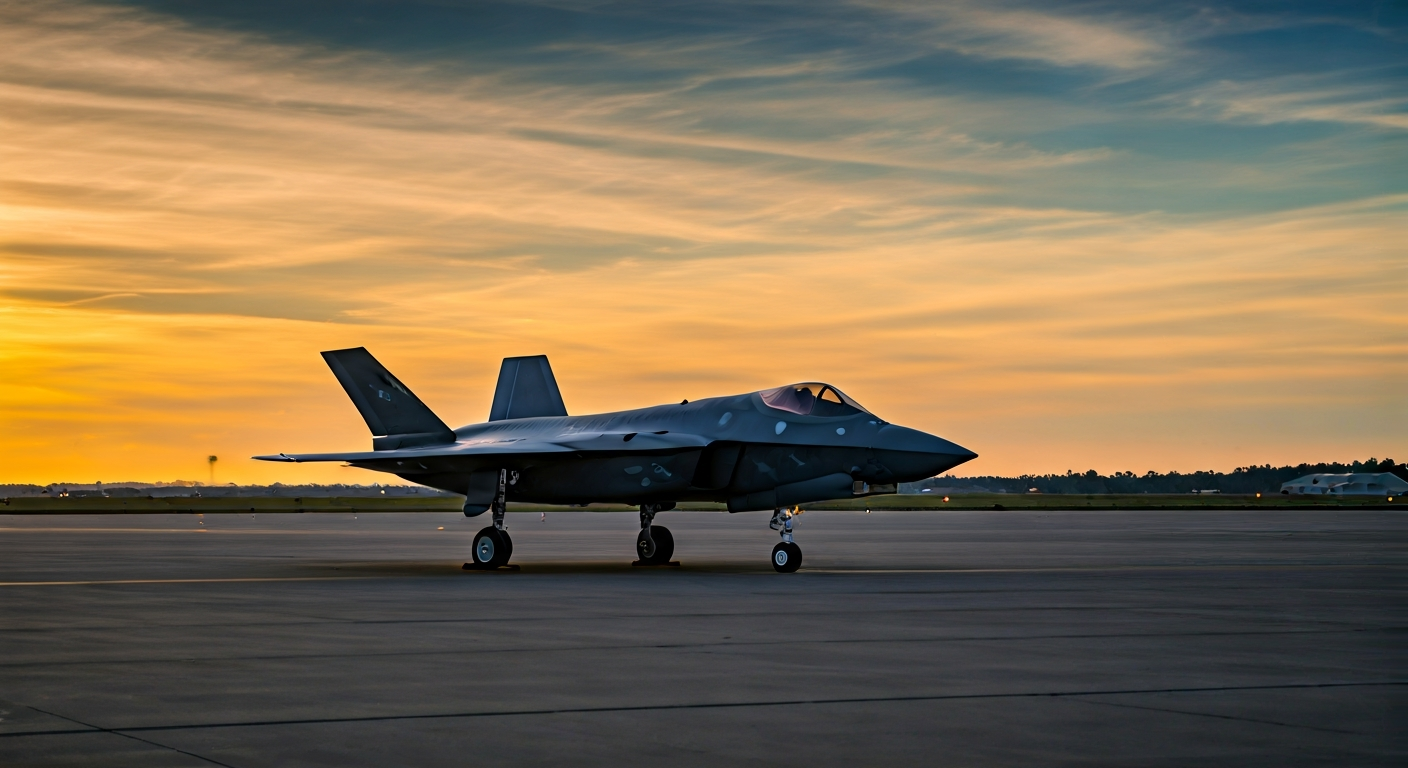
The F-22 Raptor's export ban is written into federal law - and understanding why explains everything about how America treats its most sensitive air-superiority technology.
Key takeaways
The problem America's closest allies have never been allowed to buy its best fighter, and most people don't know why.
Core insight The export ban exists because selling the F-22 means sharing classified threat libraries and stealth data, not just an airplane.
Practical outcome Readers can judge whether keeping the F-22 out of allied hands strengthened or complicated American air-power strategy.
There is a short list of weapons the United States has decided the rest of the world simply cannot have. The F-22 Raptor sits near the top of that list - and has for nearly three decades. Allies who have bought the B-2's export cousin, the F-35, have asked for the F-22. Japan, Australia, Israel - all floated the idea at various points. All were turned away. The ban is not a matter of politics or diplomatic leverage. It is written into federal law.
The F-22 Raptor's export prohibition is one of the most consequential technology-control decisions in modern American defense policy. Understanding why it exists requires looking at what the aircraft actually does - and what it would cost the United States if that capability ever left the country.
Why the F-22 Export Ban Matters Now
The question keeps resurfacing for a reason. As the F-35 Joint Strike Fighter became the backbone of allied air power across NATO, the Pacific, and the Middle East, some partners began asking whether the more capable aircraft - the one American pilots actually fly when air superiority is genuinely contested - might eventually become available. The short answer has never changed.
But the geopolitical pressure is increasing. China's J-20 stealth fighter is operational and improving. Russia's Su-57, while troubled in development, represents a genuine fifth-generation program. America's closest partners in the Pacific - Japan in particular - are facing an air-power environment that the F-35 alone may not fully address. The export ban was written for a different strategic moment. Whether it still makes sense is a debate worth having seriously.
At the same time, the F-22 production line has been closed since 2011. Only 187 operational aircraft were ever built. That scarcity alone shapes every conversation about the platform's future.
What the F-22 Actually Does
The F-22 was designed from the ground up for one mission: to own the sky. It was not built to carry bombs to fixed targets or to support ground forces in low-threat environments. It was built to defeat any opposing aircraft before that aircraft knows the F-22 is there.
That capability rests on four interlocking systems. First, its radar cross-section is extraordinarily small - the result of airframe shaping, radar-absorbent materials, and design choices that sacrifice some aerodynamic efficiency for invisibility. Second, its AN/APG-77 active electronically scanned array radar can detect, track, and engage targets at ranges that exceed most adversary platforms' ability to respond. Third, it carries weapons internally, which preserves the stealth signature that external pylons would destroy. Fourth, it is supercruise-capable - meaning it can sustain supersonic flight without using fuel-hungry afterburners, giving it a speed and energy advantage that few aircraft in the world can match.
The combination is called first-look, first-shot, first-kill. The F-22 pilot sees the threat, engages it, and turns away before the opposing aircraft has finished deciding what it is looking at.
What makes this especially difficult to replicate is not any single component. It is the integration. The sensor fusion aboard the F-22 pulls data from radar, electronic warfare systems, and datalinks into a single coherent picture. The pilot is not managing competing displays. The aircraft is managing the information and presenting what matters. That software architecture - the result of decades of iterative development - is as sensitive as any piece of hardware on the jet.
Current Military Applications
The F-22 operates primarily with the U.S. Air Force as the cornerstone of contested air operations. It has flown missions over Syria, where it operated in airspace that also contained Russian aircraft - a situation that required careful deconfliction but also demonstrated the platform's ability to operate in a complex multi-threat environment.
It has been deployed to the Pacific, to Europe following Russia's invasion of Ukraine in 2022, and to the Middle East. In each of those theaters, its role is less about the missions it flies and more about the deterrent posture it establishes. An adversary air force planning an operation must account for F-22s it cannot detect or track. That changes calculations before a single shot is fired.
Domestically, the F-22 has also been used in the less glamorous work of intercepting unidentified objects in U.S. airspace - a role that drew public attention in early 2023 when it shot down several airborne objects over North America using AIM-9X missiles.
Operational Advantages That Cannot Be Transferred
I have talked to pilots who have flown both the F-22 and the F-35. The consistent observation is that the F-22 operates in a different register entirely when the threat is a peer adversary's air force. The F-35 is versatile and highly capable. The F-22 is specialized for the most dangerous environments imaginable and built to win inside them.
The low-observable signature at the front of the aircraft is particularly significant. It is shaped specifically to defeat the frequency bands used by the most sophisticated surface-to-air missile systems and airborne intercept radars in the world. That tailoring reflects intelligence assessments that have never been made public - and that the U.S. government has no intention of making public.
This is the core of the export problem. Selling an F-22 is not just selling an airplane. It is handing over the accumulated product of classified threat assessments, classified radar cross-section testing, classified electronic warfare parameters, and classified software. The allied government receiving the aircraft would not necessarily have access to all of that material. But the aircraft itself carries it. And adversaries who study, capture, or reverse-engineer elements of the platform get it for free.
Technical and Strategic Limitations
The F-22 is not perfect. Its maintenance burden is high. Early problems with the environmental control system and oxygen generation were serious enough to ground the fleet temporarily and attracted significant congressional scrutiny. The aircraft demands more maintenance hours per flight hour than the F-15 it was designed to replace.
Its communications suite is also a known limitation. The F-22 was not designed with the same interoperability emphasis as the F-35. It can receive data from the broader tactical picture but has limited ability to transmit, which restricts how effectively it can share situational awareness with other aircraft in real time. Upgrades have addressed some of this, but the architecture reflects decisions made in the 1990s that are difficult to fully reverse.
The small fleet size is perhaps the most serious constraint. With 187 operational aircraft spread across multiple wings and global commitments, the Air Force cannot sustain high-tempo operations with the F-22 the way it can with larger fleets. In a protracted conflict, that scarcity would matter enormously.
How Adversaries Are Responding
China's answer to the F-22 problem has been partly technological and partly doctrinal. The J-20 is a genuine stealth platform, though its radar cross-section characteristics and sensor fusion capabilities remain subjects of active debate among Western analysts. Alongside it, China has invested heavily in long-range surface-to-air missile systems designed to deny American aircraft the airspace in which the F-22 excels.
Russia has pursued a similar dual track with the Su-57 and upgraded S-400 and S-500 systems. Neither country is trying to build an exact copy of the F-22. Both are trying to find the seams in what it can do.
The most serious counter-approach has been investment in low-frequency radar systems. The F-22's stealth is optimized for the radar bands that airborne intercept radars and most modern SAM systems use. Longer-wavelength systems - VHF and UHF band radars - can detect aircraft with much smaller cross-sections, though they lack the resolution to generate a weapons-quality track. China and Russia have both invested in this capability, accepting its limitations while hoping to use it for cueing more precise systems.
Procurement and Doctrine Implications of the Export Ban
The legal prohibition on F-22 exports is contained in the Obey Amendment, passed by Congress in 1998. Its reasoning was explicit: the technologies aboard the aircraft were considered too sensitive to share with any foreign government, ally or otherwise. That language has never been repealed.
What the ban has done in practice is create a two-tier system within American alliances. Partners who fly the F-35 operate a platform designed for interoperability and export. Partners who need the highest-end air superiority capability in a peer-contested environment are left with a gap. Japan's development of its own next-generation fighter - the F-X program, now being developed jointly with the UK and Italy as the Global Combat Air Programme - is a direct product of that gap. Tokyo was told the F-22 was unavailable. It decided to build something comparable on its own terms.
For American planners, the ban also creates a doctrinal dependency. If a high-end air superiority fight develops over the Taiwan Strait or the South China Sea, the U.S. Air Force cannot rely on allied F-22s to share the burden. Only American pilots fly the aircraft. That concentrates both the capability and the casualty risk in one place.
Future Scenarios
The F-22's long-term future is already being shaped by the Next Generation Air Dominance program, which aims to field a successor platform in the 2030s. What that aircraft looks like, and whether it will be any more exportable than the F-22, is not yet clear.
In the near term, three scenarios seem most likely. In the first, the F-22 continues its current role as a small, elite deterrent force while the F-35 handles the volume of allied and coalition missions. In the second, continued degradation of the fleet through attrition and maintenance costs forces an earlier transition to NGAD than currently planned. In the third, a serious crisis in the Pacific puts F-22s into actual combat against peer adversaries - a test the aircraft has never faced and that would answer many open questions about its real-world performance.
None of those scenarios involves F-22 exports. The production line is gone. Even if Congress repealed the Obey Amendment tomorrow, there is nothing left to sell.
Final Assessment
The decision to ban F-22 exports was not made carelessly. It reflected a genuine calculation that some technologies are too sensitive to share regardless of the strength of the alliance. That calculation may have cost the United States some diplomatic goodwill over the years. It almost certainly drove Japan toward independent fighter development. But it also kept the most classified aspects of American air power - the threat libraries, the electronic warfare parameters, the stealth optimization data - inside a controlled, auditable fleet.
Whether that trade-off was worth it depends on what you think the real risk is. If the risk is that an ally's aircraft gets captured, examined, or reverse-engineered, the ban made sense. If the risk is that allies face peer air threats without adequate support, the ban may have created a vulnerability of its own.
What is not in question is this: the F-22 represents a level of air-superiority capability the United States built at enormous cost and decided to keep entirely to itself. That is a statement about how Washington has understood the value of air dominance - not as a shared resource within alliances, but as a strategic reserve held in American hands. As the NGAD program moves forward, the question of whether that model still serves American interests in a coalition-dependent strategic environment is worth asking again, carefully, before the answer gets written into the next generation of law.
Frequently Asked Questions
Why is the F-22 banned from export?
The Obey Amendment, passed by Congress in 1998, explicitly prohibits the export of the F-22 Raptor to any foreign government. The reasoning centers on the sensitivity of the technologies aboard the aircraft - including its stealth optimization data, radar cross-section characteristics, electronic warfare systems, and the classified threat assessments that shaped its design. Sharing the aircraft would effectively share all of that, regardless of what a purchasing ally was told.
Could America even sell the F-22 today if it wanted to?
No, not in any practical sense. The F-22 production line at Lockheed Martin's Marietta facility was shut down in 2011 after just 187 operational aircraft were delivered. Even if Congress repealed the Obey Amendment, there would be no new aircraft to sell. Restarting the line has been studied and consistently found to be prohibitively expensive relative to the benefit.
Why couldn't allies like Japan or Australia just buy the F-22 instead of the F-35?
Both Japan and Australia formally explored F-22 acquisition and were turned away. The legal ban was the immediate obstacle, but the deeper issue is that the F-22 carries technology the U.S. government has never been willing to release outside of American operational control. Japan responded by launching its own domestic next-generation fighter program, which has since evolved into the Global Combat Air Programme developed jointly with the UK and Italy.
How does the F-22 compare to the F-35 in capability?
They were designed for different primary roles. The F-22 was built exclusively for air superiority in the most contested environments - defeating adversary aircraft before they can respond. The F-35 was designed as a multi-role platform optimized for interoperability, strike missions, and export. Pilots who have flown both generally describe the F-22 as the more capable aircraft in a peer-versus-peer air combat scenario, while the F-35 offers far greater versatility across a wider range of mission types.
What comes after the F-22 for the U.S. Air Force?
The Next Generation Air Dominance program is intended to eventually replace the F-22 in the air superiority role. The Air Force has been deliberately vague about the program's specifics, but it is expected to involve a crewed aircraft operating alongside autonomous wingmen. Whether any NGAD platform will be more exportable than the F-22 is not yet clear - the same fundamental tension between allied capability needs and technology security will apply to whatever comes next.