What Are Private Military Companies? PMCs, Security Firms, Mercenaries and the Law
By Leila Voss · October 17, 2026
Category: tactics-and-doctrine
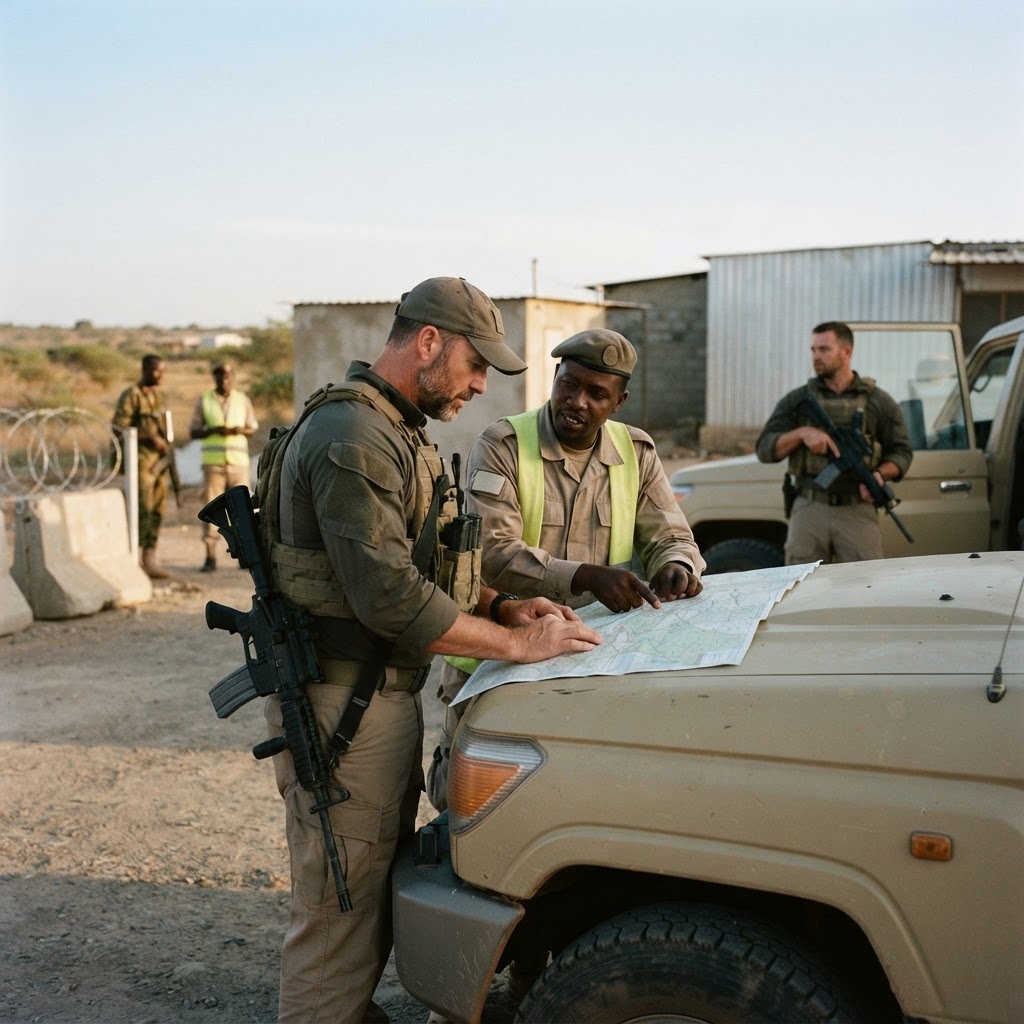
What private military companies are, how they differ from security firms and mercenaries, what the Montreux Document says, and what Africa Corps reveals.
Key takeaways
The problem PMC, private security company and mercenary are used as synonyms, which hides how different their legal status is.
Core insight A mercenary must meet six cumulative criteria under Additional Protocol I, the Montreux Document is non-binding guidance, and Africa Corps is overseen by Russian military intelligence.
Practical outcome Ask who pays, commands and is accountable for any PMC instead of relying on the word private.
A private military company is a business that sells military or security services for a fee. That one-line definition hides a lot of variation. The category covers armed guards on a merchant ship, logistics contractors in a war zone, trainers who coach a foreign army, and, in the most controversial cases, fighters who take part in combat on behalf of a state that does not want to be seen doing so.
This explainer sorts those cases out. It covers the terms, the law, the main models in use, and what the Russian experience in Africa has shown about where a "private" force ends and a state force begins.
Why Private Military Companies Matter Now

Governments outsource more of war than they usually admit. Contractors maintain aircraft, run bases, guard convoys and operate surveillance systems. Meanwhile, states with a strong reason to deny involvement have used nominally private groups to fight. Our analysis of the Wagner Group traces that second pattern, and this article steps back to give the vocabulary needed to follow it.
What the Terms Actually Mean
Three labels are often used as if they were synonyms. They are not.
- A private military company (PMC) usually refers to a firm that provides services close to combat, such as training, advice, operational support and, in some cases, direct participation.
- A private security company (PSC) usually refers to a firm that provides protective services, such as guarding people, buildings, convoys or ships.
- A mercenary is a legal term with a narrow definition in international humanitarian law.
International practice often uses the combined phrase "private military and security companies" (PMSCs), because in the field the line between a security guard and a combatant can blur. The Swiss government and the International Committee of the Red Cross (ICRC) launched the process that produced the Montreux Document, which uses that term.
The Law: Montreux and the Mercenary Definition
The Montreux Document was finalised in 2008 by 17 states. It is not a treaty. The ICRC says the document "is not legally binding as such" and instead "contains a compilation of relevant international legal obligations and good practices." It sets out what three groups of states must do: states that hire these firms, states where they operate, and states where they are based. The Swiss foreign ministry says 61 states now support it, though we note that its own page gives the count inconsistently across sections.
"is not legally binding as such"
- International Committee of the Red Cross, on the Montreux Document
The mercenary definition is separate and narrower. Under Article 47 of Additional Protocol I to the Geneva Conventions, a person is a mercenary only if all of six conditions are met. These include being recruited to fight in an armed conflict, taking a direct part in hostilities, being motivated essentially by private gain, not being a national or resident of a party to the conflict, and not being a member of a party's armed forces (summary of the six criteria). Because all six must apply, the definition is notoriously easy to avoid. A contractor who is a national of a party to the conflict, or who is formally integrated into a state's forces, is not a mercenary in the legal sense even if the work is similar.
This is the main point for readers: most PMC employees are not mercenaries in law, and calling them so is usually a political statement, not a legal finding.
How the Models Differ
Three broad models are visible in practice.
The first is the contractor model, common in Western militaries. The state hires a company through open procurement, under national law, for support tasks. The contractor is accountable to the contracting government and to its own country's regulators, though accountability gaps have been documented in past conflicts.
The second is the maritime security model. Armed guards protect commercial vessels on high-risk routes. Their work is narrowly defined as defensive, and it is regulated through flag-state rules and industry guidance.
The third is the deniable proxy model. A state uses a company that is private in name and state-directed in fact. That is the model most often discussed today, and it is the one where the label "private" does the most work and tells the reader the least.
What Africa Corps Shows
The clearest recent case is Russia. A Congressional Research Service report from April 2026 describes Wagner as "nominally private military company (PMC) linked to the Russian government" and states that "Russia formally disbanded the Wagner Group in 2023" and restructured its African operations under the name Africa Corps, which it says is "overseen by Russia's military intelligence agency," according to the CRS in Focus on Russia's security operations in Africa.
The report adds that "on the ground, Africa Corps activities may involve a mix of Russian state, ex-Wagner, and other PMC personnel." It reports as many as 2,500 Russian personnel in Mali in early 2026, about 1,500 in the Central African Republic, and a presence in Libya whose size is uncertain. These are estimates that rest on reporting, not official counts.
The lesson is structural. A rebranding that moves a group under a ministry changes how it is controlled, who answers for it and whether it can plausibly be called private. It is a state instrument, which fits the pattern we describe in why geopolitics drives defense decisions. Human rights groups have also raised serious allegations about the conduct of Russian forces in Mali, including a Human Rights Watch report in August 2026. We have not independently verified individual incidents, and we treat them as allegations by the organisation that reported them.
Strengths and Weaknesses of the Model
For a state, a private force offers speed, flexibility and, sometimes, a degree of deniability. It can be deployed without a legislative debate or a public casualty count. For the client government, it can offer security services that a weak national army cannot, often paid for with money or access to natural resources.
The weaknesses are equally clear. Command and discipline are harder to guarantee. Legal accountability is unclear. And a force paid by a patron has loyalties that can shift, a lesson the Wagner mutiny of 2023 taught Moscow directly.
Common Misconceptions
- "Private" does not mean "independent of the state." Some PMCs act as arms of a government.
- A PMC is not automatically illegal. Many operate under national licences and contracts.
- The Montreux Document is not a ban. It is guidance on how existing law applies.
Final Assessment
The phrase "private military company" covers a wide range of businesses, and the law treats them far less harshly than the word "mercenary" suggests. The questions worth asking about any PMC are practical: who pays it, who commands it, which law applies to it, and who is accountable when it causes harm. On those questions the Africa Corps case is a reminder that a corporate label can be a description of the legal form and not of the real chain of control.
FAQs about private military companies
What is a private military company?
A business that sells military or security services for a fee, from guarding and training to operational support. Some provide services close to combat.
Is a PMC the same as a mercenary?
No. A mercenary is defined narrowly in Article 47 of Additional Protocol I, and all six criteria must be met. Most contractors do not meet them.
What is the Montreux Document?
A non-binding 2008 compilation of legal obligations and good practices for states dealing with private military and security companies. It was launched by Switzerland and the ICRC.
Is Africa Corps a private military company?
The CRS says it is overseen by Russia's military intelligence agency and may mix state, ex-Wagner and other PMC personnel, so it is closer to a state instrument.
Frequently Asked Questions
What is a private military company?
A business that sells military or security services for a fee, from guarding and training to operational support.
Is a PMC the same as a mercenary?
No. Article 47 of Additional Protocol I sets six cumulative criteria, and most contractors do not meet them.
What is the Montreux Document?
A non-binding 2008 compilation of legal obligations and good practices launched by Switzerland and the ICRC.
Is Africa Corps a private military company?
The CRS says it is overseen by Russian military intelligence and may mix state, ex-Wagner and other PMC personnel.