Ukraine's Drone Industry: From 1 Million to 10 Million — And a Push for 20 Million
By Leila Voss · July 19, 2026
Category: decoding-headlines-events
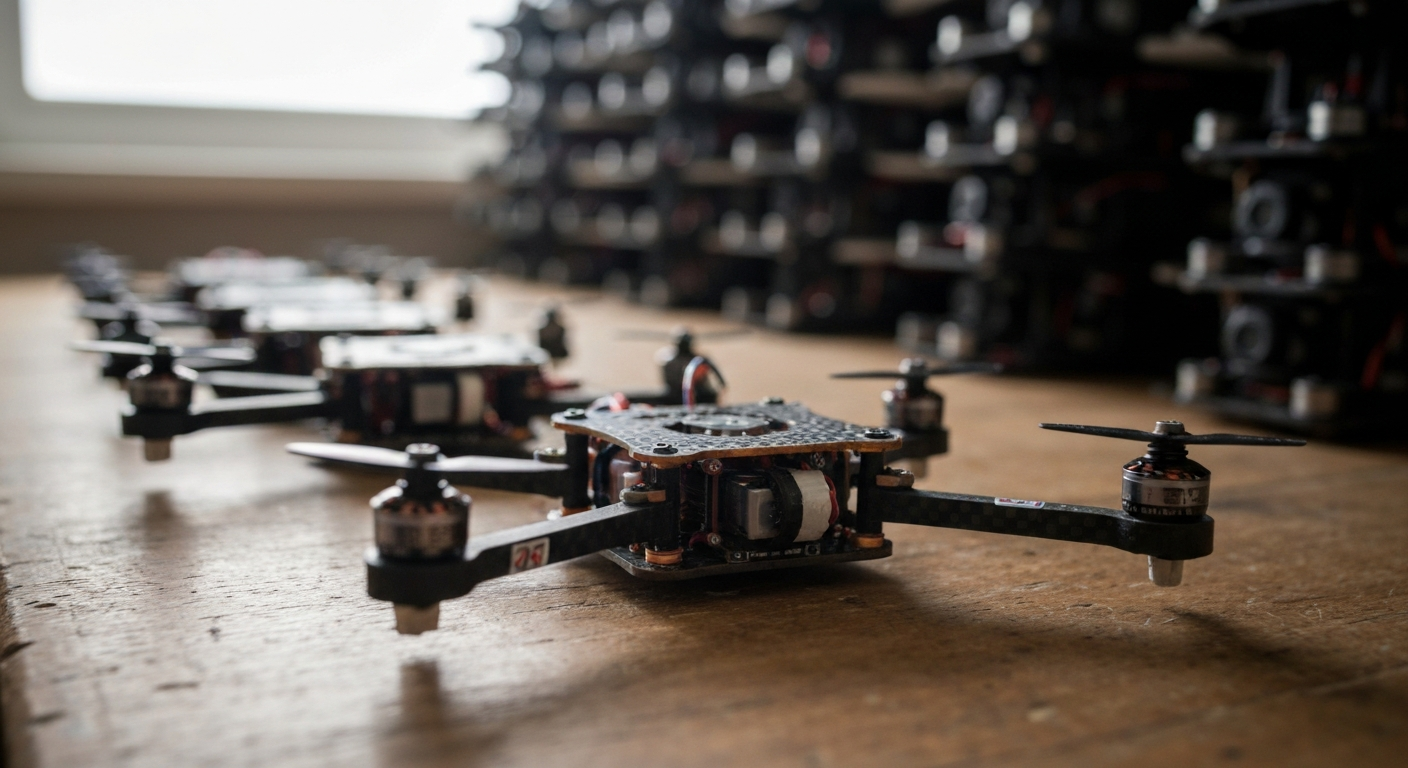
Ukraine's drone production has reached 10 million units annually, with Zelensky committing to double output to 20 million per year - but the target depends on allied funding and raises unresolved questions about supply chains, quality at scale, and actual operational demand.
Key takeaways
The problem Ukraine's drone production figures conflate confirmed output, capacity claims, and conditional targets in ways that obscure what is actually achievable.
Core insight Ten million drones annually is the confirmed baseline; reaching 20 million depends on allied funding and unresolved supply chain questions.
Practical outcome Readers can distinguish what Zelensky confirmed from what remains contingent, and know what indicators to watch for real progress.
On July 15, 2026, President Volodymyr Zelensky announced that Ukraine is producing 10 million drones annually and intends to double that figure to 20 million per year. He made the statement during ceremonies marking Ukrainian Statehood Day in Kyiv, framing the expansion as a joint effort with Ukraine's allies. The announcement builds on a June 2026 statement by Deputy Defense Minister Mstyslav Banik to the NATO Parliamentary Assembly, in which Banik confirmed the defense industry has the technical capacity to reach 20 million annually - provided it receives sufficient allied funding and support.
Both statements mark a significant distance from where Ukraine started. When Zelensky first announced a target of 1 million drones per year, the reaction at home and abroad was skeptical. That figure has since been exceeded tenfold. The 10 million annual rate is the confirmed baseline. Twenty million is a declared target, not a current reality.
What Is Confirmed and What Is Being Claimed
The 10 million figure comes from Zelensky's own public statement and is consistent with Banik's June address to the NATO Parliamentary Assembly. A 2025 Bloomberg report had placed annual production at approximately 4 million unmanned aerial vehicles (UAVs), suggesting the expansion has accelerated sharply over the intervening period.
Banik's statement deserves precise reading. He said Ukraine's defense industry has the capacity to produce up to 20 million drones annually. That is an engineering and industrial assessment, not a delivery commitment. Capacity claims do not automatically translate into supply chain reliability, consistent quality control, or stable output under wartime conditions. Banik also stated that Ukraine's defense industry is capable of manufacturing thousands of missiles for both long-range strikes and air defense systems - a significant claim that, to date, has not been independently verified in detail.
Zelensky's framing - "there will be 20 million" - is a political commitment tied explicitly to allied support. The doubling is contingent on external resources. That conditionality matters: it means the 20 million figure is simultaneously a production target, a deterrence signal, and an appeal for investment.
Why Drone Production Scale Matters Operationally
Ukraine's drone fleet has become a primary instrument of modern attritional warfare. Across the front, drones serve three distinct functions: reconnaissance and targeting, direct strike against armor and logistics nodes, and electronic warfare. These are not interchangeable categories. A first-person-view (FPV) drone optimized for a cheap kill against a vehicle is a different system from a long-range strike drone designed to reach a fuel depot 800 kilometers away. The 10 million figure almost certainly aggregates across all types, and the operational value of each type differs considerably.
The attrition rate is the underlying pressure driving these production numbers. Drones are lost to interception, mechanical failure, jamming, and direct combat at a rate that makes industrial-scale production a genuine operational requirement, not a prestige project. If Ukraine is flying tens of thousands of sorties daily across a 1,000-kilometer front, a production rate of 10 million annually - roughly 27,000 per day - is not a comfortable surplus. It is closer to a maintenance threshold.
The progression from 10 domestic drone manufacturers in 2022 to more than 500 by 2025, as described by Defense Minister Mykhailo Fedorov, reflects not just Ukrainian industrial ambition but a distributed production model that reduces vulnerability to single-point disruption. Companies such as Skyeton and Fire Point have already expanded manufacturing into Slovakia, Denmark, and the United Kingdom, frequently with European government backing. That geographic dispersal has its own strategic value: it moves some production out of range of Russian strikes.
On Wednesday, Zelensky signed a new "Drone Deal" with the European Union during European Commission President Ursula von der Leyen's visit to Kyiv, adding a formal institutional dimension to what has until now been a patchwork of bilateral arrangements.
Strategic Implications of the Announced Expansion
The shift from scarcity-managed drone operations to production-enabled sustained operations changes Ukrainian doctrine in ways that are not yet fully visible. When drones are scarce, commanders husband them for high-value targets and accept reconnaissance gaps they cannot fill. When production approaches sufficiency, saturation becomes a viable tactic - overwhelming Russian air defenses with volume, degrading logistics over wider areas, and forcing a dispersal of air defense assets that creates windows elsewhere.
The public commitment to 20 million drones annually also carries a deterrence dimension directed at Moscow. It signals that Ukraine's drone campaign is not a temporary asymmetric gamble that will fade as stockpiles deplete. It is, or is intended to be, a permanent feature of the conflict's industrial landscape. Whether Russia reads that signal as it is intended, or as an incentive to accelerate its own counter-drone and air defense investment, is a different question.
RAND analyst Michael Bohnert, speaking to Bloomberg, noted that Ukraine is producing "probably more than all NATO countries combined right now" - and that the range of drone types, not just the volume, is the operationally significant variable. That observation has not been lost on European defense ministries, several of which have quietly shifted from viewing Ukraine as an aid recipient to treating it as a defense technology testbed. Fedorov's observation that "you are not in the global defense tech market if your product has not been tested in Ukraine" captures that dynamic concisely.
Banik's appeal for allied funding at the NATO Parliamentary Assembly is worth reading carefully. It frames Ukraine's production expansion not as a sovereign capability being built in isolation but as a shared NATO-adjacent investment. That framing creates a test of allied commitment: if Western governments decline to fund the scaling, the 20 million target becomes a political statement without industrial backing. If they commit, Ukraine's drone industry becomes an asset with implications well beyond this conflict.
There is also an industrial precedent worth noting. Ukraine is a mid-sized economy under sustained military pressure, yet it has scaled drone production from a target of 1 million annually - met with open skepticism - to a confirmed 10 million. That trajectory challenges assumptions about which states can sustain meaningful defense-industrial bases under wartime conditions, and it will inform procurement and industrial policy debates across Europe for years.
What Remains Unclear
Several things are genuinely unknown, and they are not minor. Ukraine's drone production depends on foreign components: semiconductors, optics, motors, and batteries sourced from supply chains that are neither fully disclosed nor fully secured. The sources of these components, their reliability under sustained demand, and their vulnerability to trade restrictions or interdiction are not publicly confirmed.
Producing 20 million drones annually is a different engineering and logistical challenge from producing 10 million. Whether doubling output can maintain acceptable reliability and consistency - or whether it introduces quality degradation that reduces battlefield effectiveness - is not answered by the capacity claim alone.
The cost structure is also opaque. Banik said Ukraine needs "sufficient funding and support" from allies but did not specify the capital investment required, the per-unit cost across drone categories, or the timeline for reaching 20 million annually. Without those figures, allied governments cannot make informed commitments, and outside analysts cannot assess feasibility.
Finally, there is a reasonable question about whether 20 million annually reflects genuine operational demand or whether it is, in part, a negotiating position designed to maximize allied investment. The answer matters: if actual battlefield consumption could be sustained at 10 million annually with improved targeting efficiency and reduced attrition, the case for doubling looks different than if front-line shortfalls are already limiting Ukrainian operational tempo.
What To Watch Next
The Drone Deal signed with the EU on July 16, 2026 is the first concrete institutional development to monitor. Watch for the specific financial commitments attached, the categories of drones covered, and whether the agreement includes provisions for component supply chain security.
Allied funding announcements at the NATO level will be a second indicator. Track whether NATO members make bilateral or collective commitments to finance production expansion, and whether those commitments include disbursement timelines or remain aspirational pledges.
Manufacturing facility announcements - new plants, expansions of existing facilities, or production partnerships in Poland, the Baltic states, or elsewhere in Europe - will signal whether the capacity target is being translated into concrete investment decisions.
Component supply chain reporting deserves close attention. Semiconductor sourcing in particular is a persistent vulnerability. Any signs of supply bottlenecks, price pressure, or new partnerships with component manufacturers would be meaningful indicators of whether scaling is actually under way.
On the battlefield itself, monitor reports of daily drone operational density and loss rates. An increase in Ukrainian drone availability visible at the front - more saturation strikes, wider reconnaissance coverage, accelerated attrition of Russian armor and logistics - would be the most direct evidence that production figures translate into operational effect.
Frequently Asked Questions
What does 10 million drones per year actually mean in daily operational terms?
Ten million drones annually works out to roughly 27,000 units per day. Given that Ukraine operates across a front line of approximately 1,000 kilometers and loses drones to interception, jamming, and mechanical failure at significant rates, that figure is closer to a maintenance threshold than a comfortable surplus. It does not imply a stockpile is accumulating; it means production is roughly keeping pace with consumption.
Why did Ukraine's 1 million drone target face skepticism, and why should we take 20 million more seriously now?
The 1 million target seemed implausible in 2022 because Ukraine had fewer than a dozen domestic drone manufacturers at the time and lacked the supply chain infrastructure for high-volume production. The number of domestic manufacturers had grown to more than 500 by 2025, and confirmed annual output had already reached 10 million by mid-2026. The trajectory is credible; the 20 million figure is still a target, not a guarantee, but the industrial base to attempt it exists in a way it did not three years ago.
What is the difference between production capacity and actual production?
Production capacity is an engineering assessment of what a facility or industry could produce under optimal conditions. Actual production depends on consistent component supply, quality control, labor availability, funding, and logistics. Deputy Defense Minister Banik's claim that Ukraine's defense industry has the capacity to produce 20 million drones annually describes a potential ceiling, not a confirmed output. Capacity claims do not account for supply chain disruptions, component shortages, or scaling problems that can degrade consistency.
What types of drones does Ukraine produce, and are they all counted in the 10 million figure?
Ukraine produces several distinct categories: long-range strike drones capable of hitting targets hundreds of kilometers away, first-person-view (FPV) drones used for direct strikes against vehicles and personnel at short range, reconnaissance platforms, and electronic warfare variants. The 10 million aggregate almost certainly spans all categories. Their operational value differs significantly - a cheap FPV drone and a long-range strike drone are not interchangeable assets - so the aggregate figure alone does not convey the full capability picture.
Why does Ukraine need allied funding to reach 20 million drones annually if it already produces 10 million?
Scaling from 10 million to 20 million annually requires capital investment in expanded manufacturing capacity, secure component supply chains, quality assurance infrastructure, and potentially new production facilities. Ukraine's defense industry also depends on foreign components - semiconductors, motors, batteries, and optics - that must be sourced and financed. Without external investment, the industrial base may not have the capital to absorb a doubling of output. Banik's appeal to the NATO Parliamentary Assembly was explicit on this point: the target is achievable with allied support, not independently of it.