Ground Robots Are a Logistics Revolution First and a Combat One Second
By Declan Farr · October 26, 2026
Category: systems-technology-reviews
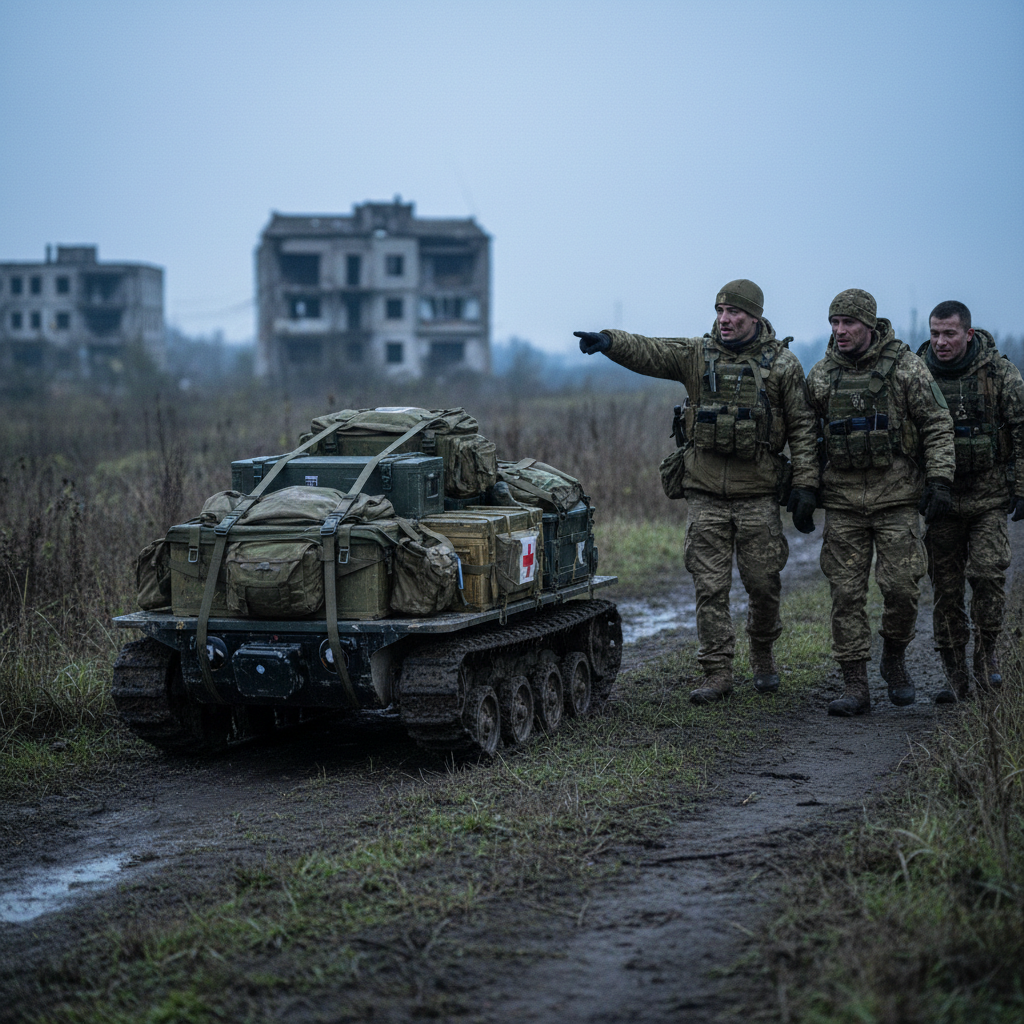
Ukraine's ground robots passed 100,000 missions in 2026, mostly resupply and evacuation. The lesson for other armies is the system, not the platform.
Key takeaways
The problem Coverage of military ground robots focuses on armed platforms, while the evidence from Ukraine shows most missions are logistics and casualty evacuation.
Core insight Ukraine logged more than 100,000 robot missions in 2026, and units report logistics and evacuation as the dominant tasks, enabled by common standards and the Delta management layer.
Practical outcome Buy standards, links and repair capacity before armed platforms, and measure success in hours of human exposure avoided.
The ground robot is arriving on the front line as a mule, not a tank. In Ukraine's most robot-heavy units, roughly 19 of every 20 ground-robot tasks involve logistics or evacuation, and combat is a small minority. That ratio is the most important fact about unmanned ground vehicles in 2026, and most coverage buries it under footage of armed machines.
This analysis uses Ukrainian Ministry of Defence data and the most detailed public assessment so far, a September 2 War on the Rocks study by Lesia Bidochko, a policy fellow at the European Policy Institute in Kyiv. It argues that the lesson for other armies is the system around the robot, and that buyers who chase armed platforms first are optimizing the wrong thing.
Why Ground Robots Matter Now

Drones have emptied the front of people. Units scatter and fortify, which increases demand for batteries, electronic warfare equipment and construction materials while making deliveries harder. Bidochko describes a chain in which loads move from trucks to pickups to all-terrain vehicles and finally to soldiers on foot, with each transfer reducing capacity and creating patterns that enemy reconnaissance can detect. Casualty evacuation runs the same chain in reverse, with documented cases of soldiers walking up to 25 kilometers.
The Ukrainian Ministry of Defence reports that units have carried out more than 100,000 logistics and evacuation missions with ground vehicles since the start of 2026, all recorded in the DELTA combat system. It states: "Each of these missions represents Ukrainian service members' lives potentially saved." Bidochko puts the total at more than 100,000 frontline missions by August 20 and calculates one robot sortie roughly every three and a half minutes.
What the Technology Actually Does
The robots work at the narrowest point of the supply chain, between the last place conventional vehicles can reach with tolerable risk and positions that still need a physical connection to the rear. They are not invulnerable. Mines, first-person-view drones, small-arms fire, broken communications and terrain destroy them often. The calculation is that losing a machine is better than losing a person.
Two episodes show the logic. In March 2026 near Pokrovsk, commanders judged a route too mined and exposed for a conventional vehicle, so a Bizon ground robot traveled about 12 kilometers each way, over 12 hours, to retrieve a casualty. A first-person-view drone struck it and it briefly lost communications, but the soldier survived. In another case a soldier trapped near Russian positions for 33 days was reached only by the seventh robot. Six were destroyed, and the seventh completed a 64-kilometer mission. Traditional attrition metrics would call that a disaster. Compared with sending rescue teams through the same drone-covered ground, Bidochko argues, it was justified.
Current Military Applications
The scale is already large. In the 21st Unmanned Systems Regiment, ground robots handle up to 90 percent of deliveries. In the 3rd Assault Brigade, monthly robotic deliveries rose from 30 tons in January 2025 to 300 tons a year later, and the brigade reports that all battlefield evacuations are now done by robots. Between January and May 2026, the number of Ukrainian units using ground robots nearly doubled, from 117 to 230.
Combat use makes headlines because it is novel. In July 2026, fighters of the 123rd Brigade said an uncrewed surface vessel carried a ground robot with a remotely operated 7.62 mm combat module across the water and released it ashore, which they described as probably the first combat mission of its kind. Bidochko treats it as an exception: "most robotic missions will never" make headlines.
Operational Advantages
The advantage is exposure avoided, not enemies destroyed. A 2024 Ukrainian General Staff model estimated that systematic use of ground robots could cut personnel losses in supported units by up to 30 percent. That figure is a model, not a measurement, and it belongs to a manpower-constrained army fighting a positional war along repeatedly watched routes. It should not be exported without that context.
The robots also change command. Third Army officers told Bidochko that robots cut paperwork and gave a battle captain a shared real-time picture to coordinate units directly. Those are reported impressions from a single source, and worth testing elsewhere.
Technical and Strategic Limitations
Three limits stand out. First, terrain. Platforms that perform on test ranges often meet their hardest ground for the first time in combat, so local modification is routine. Second, communications. Early robots were designed for control ranges of two to five kilometers, while resupply routes now run 15 to 20 kilometers at speeds up to 15 kilometers an hour, meaning a mission may need hours of uninterrupted control. Units alternate among radio, Starlink, fiber-optic cable and aerial relays. Third, operator attention. Each additional drone generally requires another operator, and the CEO of Ark Robotics estimates that no more than one percent of systems used in combat are truly autonomous.
How Adversaries May Respond
Russia has documented at least 32 ground robotic models and confirmed combat use for at least 20, according to Bidochko, but its mission volume is far lower than Ukraine's. The likely response to robot logistics is to attack the robot's chain: the relays, the links and the repair points. That is why the integrating layer matters more than the vehicle. Our analysis of Ukraine's hunt for Russian jammers shows how central the communications contest has become.
Procurement and Doctrine Implications
The study makes a pointed argument about buying. More than 200 Ukrainian manufacturers can supply what functions as a single fleet because of common standards. Delta plans and tracks ground-robot missions alongside aerial and maritime ones, and a second system, ePoints, verifies completed sorties and lets units exchange points for equipment. Bidochko's conclusion: the lesson "is not 'buy more robots,'" it is that robots without an integrating layer are isolated tools.
"What matters is not the robot itself, but the chain that starts in orbit, moves through spectrum, software, navigation, and forward repair, and ends at the trench."
- Lesia Bidochko, War on the Rocks
The implications for Western armies are plain. Buy standards and open interfaces first. Buy small batches tied to verified use. Measure success in tons delivered, casualties extracted, repair time and hours of human exposure avoided. Expeditionary forces face a harder test than Ukraine, because spares, repair teams and recovery capacity must travel with the fleet. For the broader context of Ukraine's production base, see our report on its drone industry.
Future Scenarios
Expect logistics robots to spread first, because the business case is clearest and the political risk lowest. Armed ground robots will follow where operators and links can be protected. Hybrid designs that cross the ground-air line, such as the one in our look at Russia's patented hybrid, will test how far the concept stretches.
Final Assessment
Ground robots are a labor revolution first. They absorb the most dangerous hours of the supply chain, and that is where the evidence is strongest. Armies that start with armed machines will learn what Ukraine learned: the vehicle is the least difficult part. The fleet's value is set by standards, links, software and repair, and a force that builds those first will field useful robots sooner than one that buys the most impressive platform.
FAQs about military ground robots
What do military ground robots mostly do?
In Ukraine, mostly logistics and casualty evacuation. In the 3rd Assault Brigade, roughly 19 of every 20 ground-robot tasks involve logistics or evacuation.
How many ground robot missions has Ukraine flown?
The Ukrainian Ministry of Defence reports more than 100,000 logistics and evacuation missions since the start of 2026, recorded in the DELTA system.
Do ground robots reduce casualties?
A 2024 Ukrainian General Staff model estimated reductions of up to 30 percent in supported units. It is a model for Ukraine's specific conditions, not a measurement.
What limits ground robots?
Terrain, communications range under electronic attack and operator attention. Each additional drone generally needs another operator.
What should other armies copy?
Common standards, open interfaces and a management layer such as Delta, plus small procurement batches tied to verified use.
Frequently Asked Questions
What do military ground robots mostly do?
In Ukraine, mostly logistics and casualty evacuation. In the 3rd Assault Brigade, roughly 19 of every 20 ground-robot tasks involve logistics or evacuation.
How many ground robot missions has Ukraine flown?
The Ukrainian Ministry of Defence reports more than 100,000 logistics and evacuation missions since the start of 2026, recorded in the DELTA system.
Do ground robots reduce casualties?
A 2024 Ukrainian General Staff model estimated reductions of up to 30 percent in supported units. It is a model for Ukraine's specific conditions, not a measurement.
What limits ground robots?
Terrain, communications range under electronic attack and operator attention. Each additional drone generally needs another operator.