The Strait of Malacca is the artery of Asian trade — and China’s biggest maritime vulnerability.
By Declan Farr · May 15, 2026
Category: tactics-and-doctrine

The Strait of Malacca carries nearly half of global trade through a passage barely two miles wide - and China's dependence on it is the most significant maritime vulnerability in modern strategic competition.
Key takeaways
The problem China built its economy around sea lanes it cannot protect against a determined adversary.
Core insight The Malacca Dilemma gives potential adversaries financial leverage over China before any military action begins.
Practical outcome Readers can recognize why U.S. partnerships with Indonesia matter more than any single warship procurement.
The Strait of Hormuz gets the headlines whenever tension rises in the Persian Gulf. Tankers divert, insurance premiums spike, and oil markets react within hours. But there is another strait, narrower at its pinch point, carrying roughly three times the daily oil volume of Hormuz, threading between two continents and connecting the Indian Ocean to the South China Sea. The Strait of Malacca does not generate the same breathless news coverage. It does not need to. Its strategic weight is so fundamental to Asian trade and energy supply that its disruption would be less a crisis than a civilizational rupture - and no country understands this more anxiously than China.
The Strait of Malacca runs approximately 550 miles between the Malay Peninsula to the north and the Indonesian island of Sumatra to the south. At its narrowest, near the Phillips Channel off Singapore, it measures roughly 1.7 miles of navigable water. Through that gap passes an estimated 40 percent of global trade by volume, including the majority of energy imports that fuel the Chinese, Japanese, South Korean, and Taiwanese economies. For China specifically, the strait is not merely an important shipping lane. It is the primary route through which Chinese industry stays alive.
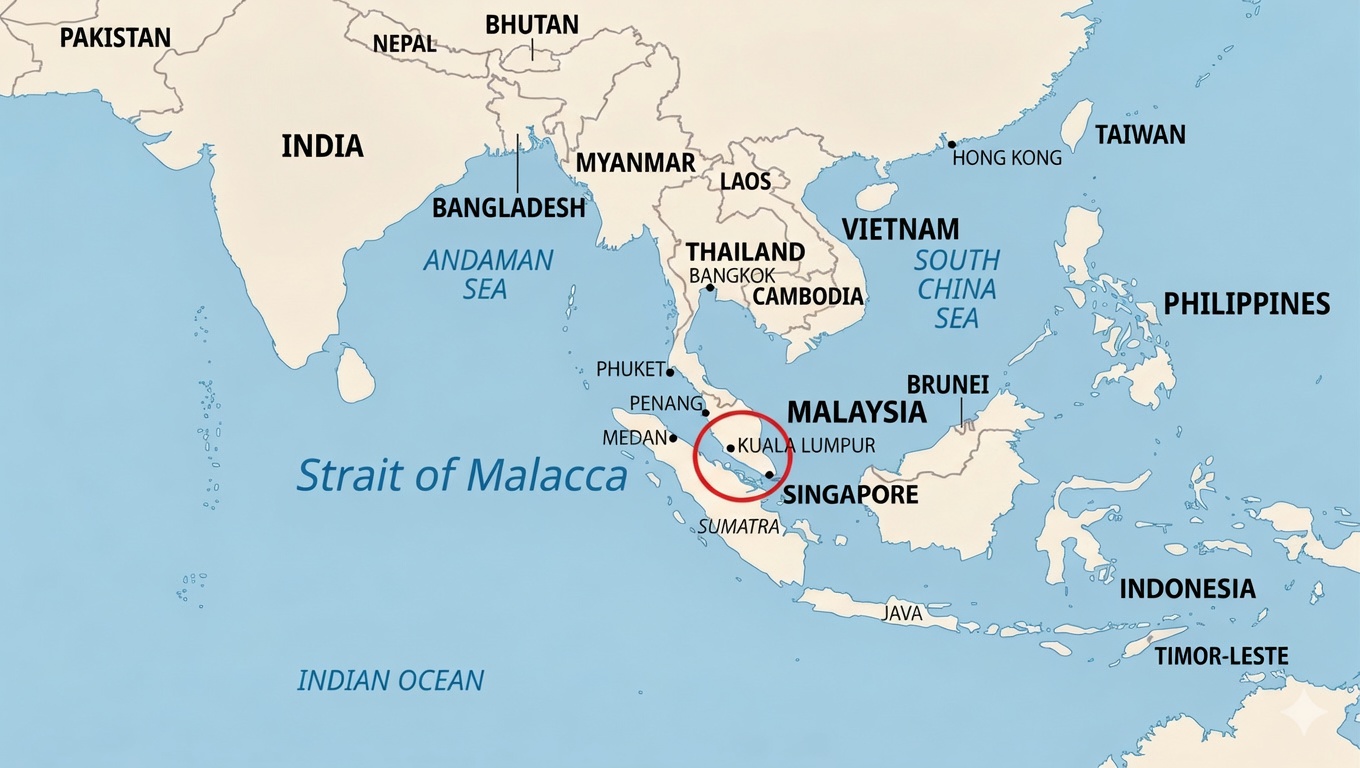
What the Malacca Dilemma Means for Chinese Strategy
The term "Malacca Dilemma" entered Chinese strategic discourse in a 2003 speech by President Hu Jintao, though the anxiety it names is older than the phrase. The dilemma is straightforward in its structure and deeply uncomfortable in its implications: China depends on seaborne energy and trade to sustain its economy, the overwhelming majority of that seaborne traffic passes through a single narrow chokepoint, and China lacks the naval capability to secure that chokepoint against a determined adversary.
The People's Liberation Army Navy has grown enormously over the past two decades. China now operates a blue-water fleet with aircraft carriers, modern destroyers, and nuclear-powered submarines. But the Strait of Malacca sits at the intersection of waters that the United States Navy, operating from bases in Japan, Guam, Diego Garcia, and increasingly through partner arrangements across the Indo-Pacific, can reach and influence far more readily than Chinese surface forces can defend. A blockade or even a credible interdiction threat in the strait would, in the event of a major conflict, threaten to throttle the Chinese economy without firing a shot at the Chinese mainland.
Why This Vulnerability Developed
Geography is the short answer, but the longer one runs through decades of Chinese industrialization and strategic miscalculation about the durability of American restraint. China's coastal provinces industrialized rapidly from the 1980s onward, drawing in raw materials - iron ore from Australia, copper from Africa, crude oil from the Persian Gulf and West Africa - almost entirely by sea. The infrastructure of Chinese industry assumed open sea lanes because, for a generation, open sea lanes were a reasonable assumption. The United States maintained the world's dominant navy and had, broadly speaking, an interest in free passage for commercial traffic.
That assumption is now contested. The trade relationship between Washington and Beijing has deteriorated, military-to-military trust has eroded, and American strategic attention has rotated toward the Indo-Pacific with unmistakable intent. China finds itself with an economy built around seaborne supply chains and a navy that, however capable it has become in the Western Pacific, cannot yet project sustained power to the Indian Ocean approaches of Malacca. The vulnerability was baked in long before anyone in Beijing had reason to treat it as urgent.
How the Dilemma Works in Practice
The practical mechanics are worth spelling out, because the threat does not require an actual blockade to function. The mere possibility of interdiction - a credible signal that the strait might close or become dangerous to transit in a crisis - would drive insurance costs for vessels carrying Chinese cargo through the roof. Chinese firms would struggle to secure supply contracts. Tanker operators would demand premiums that made Chinese import economics unworkable. The leverage is financial before it is military.
Beyond economics, a hostile naval presence in or near the strait during a conflict would force Chinese planners to disperse their energy imports through longer, more expensive routes - around the southern tip of Australia, or through pipelines that do not yet exist at sufficient scale. The China-Myanmar oil and gas pipeline provides some overland bypass capacity to Yunnan province, but it handles a small fraction of China's daily crude requirement. The proposed land routes through Central Asia serve different supply origins and face their own logistical constraints. No alternative comes close to replacing the volume that transits Malacca.
Historical Examples of Strait Leverage
The British understood chokepoint strategy before it had a name. Their basing at Singapore from the early nineteenth century was not merely a commercial calculation - it was the recognition that whoever held the southern approaches to the South China Sea controlled the rhythm of regional trade. When Singapore fell to Japanese forces in February 1942, the strategic shock ran far deeper than the territorial loss. It demonstrated that the linchpin of British power in Asia was a single fixed point that could be cut.
Japan's own experience in the Pacific war is instructive from the other direction. The American submarine campaign against Japanese shipping, including traffic through the Malacca Strait and the sea lanes connecting Japan to its resource territories in Southeast Asia, strangled the Japanese war economy by 1944. Japan, like China today, had built its military-industrial capacity around seaborne supply. The United States did not need to invade the Japanese home islands to break that system. It needed to make the sea lanes untenable.
These are not comfortable historical parallels for Chinese strategists to sit with, and they do not.
Current Applications and the U.S.-Indonesia Dimension
The contemporary strategic picture around Malacca has grown more active in the past few years. The United States has deepened its defense cooperation with Indonesia, which is one of the three sovereign states - alongside Malaysia and Singapore - that border the strait. This development does not give the United States any form of control over the Strait of Malacca itself. Passage rights are governed by international law and the consent of the littoral states, none of which are American allies in the formal treaty sense.
What the U.S.-Indonesia defense cooperation does accomplish is something more subtle and, from Beijing's perspective, more durable. It deepens the relationship between American military planners and Indonesian counterparts, creates pathways for intelligence sharing, and could provide the United States with greater operational and surveillance flexibility in waters adjacent to one of China's most sensitive maritime routes. American access to Indonesian facilities and airspace near the Sunda Strait - an alternative passage between Sumatra and Java - and the Lombok Strait, further east, matters because these are the secondary chokepoints that Chinese shipping would need to use if Malacca became unavailable.
In other words, American engagement with Indonesia does not close the front door. It also begins to watch the back doors.
Strengths and Weaknesses of China's Strategic Position
China has not sat idle. The Belt and Road Initiative is, among other things, an attempt to build overland and alternative maritime infrastructure that reduces dependence on any single chokepoint. The China-Pakistan Economic Corridor theoretically offers a route from the Persian Gulf to China's western provinces via Gwadar port. The development of relationships with port facilities in Sri Lanka, Myanmar, and along the East African coast reflects an attempt to pre-position logistical options.
The weakness is that none of these projects are mature enough, or carry enough capacity, to substitute for Malacca in a real crisis. Overland pipelines move oil at a fraction of the speed and volume that tankers do. Road and rail infrastructure through mountainous terrain is vulnerable to interdiction in ways that are different from maritime chokepoints but no less real. And the political reliability of partner states along these corridors is not guaranteed - Pakistan's internal instability, Myanmar's civil conflict, and the shifting alignments of smaller Indian Ocean states all introduce variables that Chinese planners cannot fully control.
The strength China does hold is time. Every year the PLAN grows more capable, and every year the prospect of sustained American naval operations close to Chinese shores becomes more complicated. If China can delay the moment of crisis long enough, the strategic geometry may shift in its favor.
What Adversaries Get Right - and Where They Overestimate
American and allied planners are correct that the Malacca chokepoint represents genuine and enduring Chinese vulnerability. The geography is not going to change, and the dependency on seaborne energy is structural. Where Western strategists sometimes overreach is in treating this vulnerability as a reliable lever rather than a contested one. China has signaled clearly and consistently that it regards economic strangulation as a form of existential threat - meaning that the deterrent value of Malacca depends on the adversary believing China will act rationally and incrementally under that kind of pressure. History does not always support that expectation.
There is also the question of escalation. A blockade of Chinese shipping through Malacca would almost certainly be treated in Beijing as an act of war, not as coercive pressure short of war. Any American administration that chose to exercise that option would need to be prepared for what comes next. The chokepoint is powerful precisely because using it carries enormous risk.
Future Relevance of the Malacca Question
The strait's strategic weight is unlikely to diminish. Asian economies are not de-industrializing, energy demand across the region continues to grow, and the geographic reality is fixed. What may change is the military balance around it. Chinese carrier-based aviation, longer-range undersea capabilities, and the continued development of the PLAN's surface fleet will eventually complicate any assumption of easy American dominance in the broader region. Chinese investment in alternative energy - solar, nuclear, and eventually hydrogen - may at the margins reduce the oil dependency that makes Malacca so acute. But these are decade-scale trends, not near-term shifts.
In the meantime, the U.S. approach of deepening relationships with Indonesia, Singapore, and other Indo-Pacific partners represents the patient accumulation of positioning - less dramatic than a new class of warship, but in some ways more durable. Access, basing rights, interoperability, and shared intelligence are the currency of chokepoint strategy in the modern era.
Final Assessment
The Strait of Malacca is not a metaphor. It is 1.7 miles of water that carries the energy and trade flows on which Chinese prosperity depends, bordered by states that are not Chinese allies, watched by a navy that is not Chinese, and already the subject of seventy years of strategic calculation by every major power with interests in Asia. China's Malacca Dilemma is real, it has no clean solution, and it will shape Chinese strategic behavior - from naval procurement to Belt and Road investments to the calculus around Taiwan - for as long as the current international order holds. Understanding the Strait does not tell you everything about Chinese strategy. But you cannot understand Chinese strategy without it.
Frequently Asked Questions
What is the Strait of Malacca and why does it matter?
The Strait of Malacca is a narrow sea passage running roughly 550 miles between the Malay Peninsula and the Indonesian island of Sumatra. At its narrowest point it measures about 1.7 miles of navigable water. It is the primary maritime route between the Indian Ocean and the South China Sea, carrying an estimated 40 percent of global trade by volume and the majority of oil and gas imports flowing to China, Japan, South Korea, and Taiwan. Its importance comes from a combination of geography and the absence of viable alternatives at scale.
What is the Malacca Dilemma?
The Malacca Dilemma is a term used in Chinese strategic thinking to describe a fundamental vulnerability: China depends on seaborne energy and trade, most of which passes through the Strait of Malacca, yet China lacks the naval power to secure that chokepoint against a determined adversary. The phrase entered public discourse in a 2003 speech by President Hu Jintao. It captures the tension between China's economic structure, which was built around open sea lanes, and the increasingly contested nature of the Indo-Pacific maritime environment.
Could the United States actually blockade China through the Strait of Malacca?
In principle, yes - but with significant caveats. A blockade or sustained interdiction of Chinese shipping through Malacca would require the cooperation or acquiescence of the three littoral states (Malaysia, Indonesia, and Singapore), and it would almost certainly be treated by Beijing as an act of war rather than coercive pressure short of conflict. The leverage the strait provides is real but double-edged: exercising it carries escalation risks that would give any administration serious pause. The more likely use of the chokepoint in a crisis would be through insurance and commercial pressure rather than overt naval blockade.
What does the U.S.-Indonesia defense cooperation mean for Malacca?
The U.S.-Indonesia defense cooperation does not give the United States control over the Strait of Malacca, which is governed by international law and the sovereign rights of its bordering states. What it does is deepen military-to-military ties, intelligence sharing, and operational familiarity between American and Indonesian forces. This could provide the United States with greater surveillance and operational flexibility near the strait and near alternative passages like the Sunda and Lombok straits, which Chinese shipping would need if Malacca became unavailable. It is strategic positioning rather than operational control.
Is China doing anything to reduce its dependence on the Strait of Malacca?
China has pursued several approaches, most notably through the Belt and Road Initiative. The China-Pakistan Economic Corridor, connecting Gwadar port in Pakistan to China's Xinjiang province, offers a theoretical overland bypass of Malacca for Persian Gulf oil. The China-Myanmar oil and gas pipeline provides some direct access to Yunnan province. Chinese investment in renewable energy may at the margins reduce oil import dependency over the long term. However, none of these alternatives currently come close to matching the volume that transits Malacca daily, and each faces its own logistical and political vulnerabilities.