Russia Patents a UGV-UAV Hybrid Robot: What the Autonomous Tank-Drone System Means for NATO
By Marcus Hale · July 12, 2026
Category: systems-technology-reviews
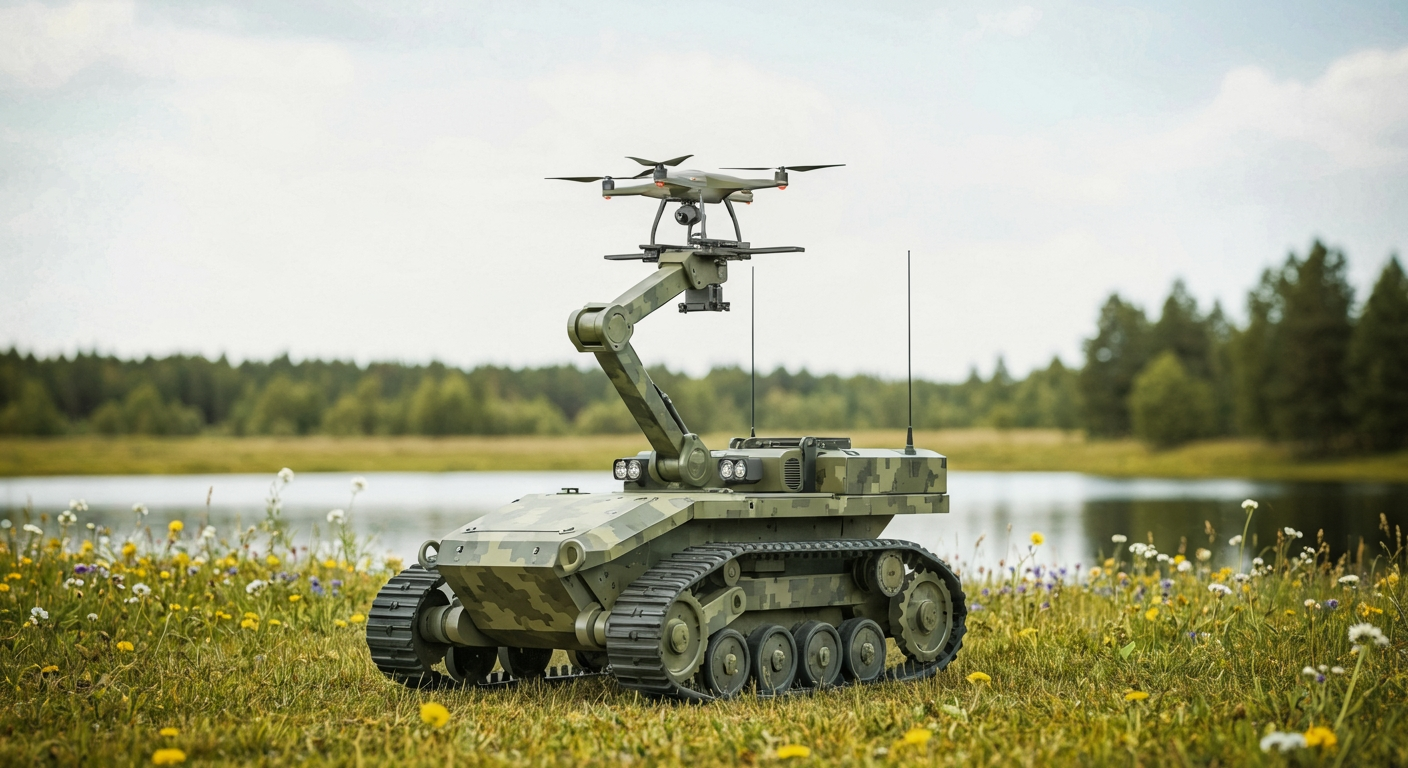
Russia has patented a tracked ground robot that carries and autonomously deploys its own miniature quadcopter - a Russian robot tank drone concept that reveals where Russian military robotics doctrine is heading, and what it means for NATO.
Key takeaways
The problem Most coverage treats Russia's robot tank drone as a novelty without examining what it reveals about Russian military doctrine.
Core insight The patent matters less as a weapon description than as evidence of Russia's push toward fully autonomous, operator-free reconnaissance.
Practical outcome Readers can assess the system's real limits and what NATO or Ukraine would actually need to counter it effectively.
A Russian patent for a small tracked ground robot that carries, deploys, and recovers its own miniature quadcopter has surfaced in open-source defense tracking communities, and it is worth taking seriously - not because Russia is about to field it tomorrow, but because of what it tells us about where Russian military robotics thinking is heading. The concept is straightforward: a compact tracked platform rolls to a forward position, launches an aerial drone for reconnaissance, receives the sensor feed, and recovers the aircraft when the mission is done. No human operator in the loop. No separate drone crew. One system, two domains.
Patent filings are not hardware. They are intent made public. But in defense analysis, intent matters - especially when it fits a broader pattern.
Why Russian UGV-UAV Integration Matters Now
The operational logic behind this kind of system is not complicated. Every time a soldier walks forward to get eyes on a position, or a drone operator transmits on a frequency that can be detected, there is exposure. An autonomous ground platform that deploys its own aerial sensor removes that exposure almost entirely. The human stays back. The machine goes forward, looks around, and comes home.
Russia has been moving toward this kind of distributed, attrition-resistant reconnaissance for years. The widespread use of FPV drones, loitering munitions, and decentralized drone operations in Ukraine reflects a doctrine built around removing human operators from the most dangerous parts of the kill chain. A UGV that carries its own UAV is the next logical step in that progression - a reconnaissance asset that requires no radio-linked operator close to the front and no separate aerial platform assigned from higher command.
What this patent signals, then, is not a single weapon. It is a doctrinal ambition: autonomous, multi-domain, small-unit reconnaissance conducted without human presence in the sensor loop. If Russia gets this working at scale, NATO and Ukrainian forces face a reconnaissance threat that is genuinely harder to intercept than a human-piloted drone, because there is no pilot signal to triangulate and no operator to disorient.
That is the strategic headline. The engineering details are where things get more complicated.
What the Patent Describes
The design centers on a compact tracked chassis - small enough to be carried forward by a handful of soldiers or loaded into a vehicle, in the general weight class of existing Russian EOD and reconnaissance robots like the Vikhr family. Mounted on or integrated into the chassis is a docking cradle for a miniature quadcopter. The ground platform navigates to a designated position, the quadcopter launches, conducts aerial reconnaissance, and the system autonomously recovers the aircraft onto the docking cradle.
The integration architecture is what makes this novel, not the individual components. Tracked robots exist. Quadcopters exist. The hard engineering problems are the docking mechanism that allows reliable recovery in field conditions, the power transfer system that recharges the drone between sorties, and the autonomous data handoff that lets the ground platform process and relay imagery without human intervention.
The quadcopter's sensor suite is not fully specified in available patent documentation, but the form factor points toward an electro-optical camera as the primary payload, with possible infrared capability for low-light operations. Signals intelligence collection is conceivable at this scale but would require trading off against flight endurance. A drone small enough to dock on a tracked robot is going to be flying for somewhere between ten and twenty minutes per sortie, with an effective reconnaissance radius measured in low single-digit kilometers. Those are not generous numbers, but they are enough to look over a ridgeline or check the far side of a building before committing troops.
Current Military Applications and Precedents
Russia's existing reconnaissance robot inventory has real limitations. Platforms like the Vikhr and various Uran variants are useful for EOD work and short-range surveillance, but they either require an operator with a control unit nearby or are tethered to a command post. Neither option is ideal when the objective is to push reconnaissance past the line of contact without exposing personnel.
Western militaries have explored similar integration concepts. The U.S. Army has experimented with pairing micro-UAVs like the Raven and Wasp with ground platforms, and several defense contractors have demonstrated UGV-launched aerial systems in research environments. What distinguishes the Russian approach - at least on paper - is the emphasis on a fully integrated, single-chassis system designed for autonomous operation rather than operator-assisted deployment. The Western programs have generally kept the human closer to the launch decision.
The battlefield context in Ukraine makes the patent's timing legible. Russian forces have spent two years refining the coordination between FPV drone teams and ground units. The pattern is well documented: a drone spots a target, relays position, ground forces maneuver. This patent describes automating the first part of that sequence. The drone goes out, looks, comes back. The ground commander gets imagery. The kill chain gets shorter.
Operationally, the most plausible deployment scenarios are forward reconnaissance in open or semi-urban terrain, checking contested logistics routes before vehicle convoys move, and force protection around static positions where a hovering drone would immediately draw fire but a grounded robot might go unnoticed.
Operational Advantages
The most direct benefit is operator survivability. A system that can conduct aerial reconnaissance without a human within several kilometers of the target eliminates one of the more dangerous jobs on the modern battlefield. A drone operator at a fixed position is a detectable radio source. A fully autonomous system removes that signature.
The second advantage is decentralization. Small unit leaders who currently have to request drone support from higher command - and wait for it - could, in principle, have organic reconnaissance capability assigned at squad or platoon level. That changes how quickly a unit can develop situational awareness and act on it. The kill chain compression matters as much as the individual tactical advantage.
The third advantage is survivability through integration. A quadcopter hovering over a position is immediately visible and immediately targetable. A tracked ground platform moving through vegetation or rubble is much harder to detect from the air and far more resistant to small-arms fire than any aerial drone. The system can shelter the quadcopter until the moment it is needed, which extends the overall survivability of the reconnaissance asset.
Cost and scalability follow from form factor. A small integrated system - if producible at volume - is almost certainly cheaper than maintaining separate UGV and UAV inventories with separate operator training pipelines. At sufficient scale, the economics become a strategic argument in themselves.
Technical and Strategic Limitations
The endurance numbers are the first honest constraint. Ten to twenty minutes of flight time and a reconnaissance radius of one to three kilometers puts a hard ceiling on what this system can see in a single sortie. Larger UAVs - or manned aviation - cover far more ground. For deep reconnaissance or persistent surveillance, a docked miniature quadcopter is not the right tool.
Payload is the second constraint. A drone small enough to dock on a compact tracked chassis cannot carry sophisticated sensors. High-resolution imaging, thermal cameras capable of detecting camouflaged positions, and signals intelligence collection all add weight and power consumption. The likely sensor suite is a basic electro-optical camera, which is useful but hardly definitive against a prepared adversary. What you see at five hundred meters in daylight is not what you need to see at two kilometers in overcast conditions.
Weather matters more than most patent descriptions acknowledge. Miniature quadcopters are sensitive to wind above roughly ten to fifteen knots. In the kind of mixed terrain and variable weather conditions that define Ukrainian winters, the operational availability of a small drone may be significantly lower than its nominal capability suggests. Electronic warfare compounds this: if the system relies on GPS for autonomous navigation or radio links for data relay, it sits squarely in the target set for jamming and spoofing systems that both sides have deployed extensively.
And then there is the docking mechanism itself. Recovering a small quadcopter onto a moving or stationary tracked platform in field conditions - mud, vibration, crosswind - is an engineering problem that laboratory prototypes routinely underestimate. Failure rates in actual field use tend to be higher than patent drawings suggest.
How NATO and Ukrainian Forces May Respond
Electronic warfare is the most immediate countermeasure. Ukraine has developed sophisticated jamming and spoofing capabilities over the past two years, and both GPS-dependent navigation and radio-linked data relay are known attack surfaces. A fully autonomous UGV-UAV system that relies on either would need robust electronic protection to operate in a contested electromagnetic environment - and that protection adds cost, weight, and complexity.
Kinetically, small tracked robots are not armored vehicles. Small-arms fire, artillery fragmentation, and anti-drone systems designed for aerial targets can all threaten a ground robot that has to stop or slow down to conduct a launch-and-recovery cycle. Ukrainian forces have built considerable institutional knowledge around detecting and destroying Russian reconnaissance assets. A robot sitting still long enough to recover a drone is a target.
Doctrinally, Ukrainian counter-drone operations have evolved rapidly. Artillery targeting of drone operators, counter-UAV systems, and radio direction-finding have all been adapted for the specific signatures that Russian drone operations generate. An autonomous system changes some of those signatures - no operator to locate - but introduces others, particularly during the ground movement phase.
NATO procurement responses are harder to predict. Some member states will look at Russian UGV-UAV integration and move to develop comparable systems. Others may judge that investment in larger, more capable networked ISR platforms - or AI-assisted targeting systems - offers better return on defense spending than fielding small autonomous robots at squad level. The answer will differ by country, budget, and perceived threat priority.
Procurement and Doctrine Implications
Patents typically precede production by two to five years, and that assumes a functioning industrial base, an adequate supply chain, and genuine organizational will to integrate a new system into doctrine. Russia's defense manufacturing sector is under sustained pressure from export controls and wartime demand. Whether the industrial capacity exists to produce UGV-UAV hybrids at meaningful scale, on top of existing production commitments, is a legitimate question that the patent itself cannot answer.
Doctrinal integration raises its own complications. Russian military command structures are not historically well suited to the kind of decentralized, small-unit autonomy that a squad-level reconnaissance robot implies. Assigning autonomous ISR capability at platoon level requires training, trust in the system's outputs, and a willingness to act on machine-derived intelligence without waiting for command confirmation. Those are cultural and institutional changes, not just procurement decisions.
Training pipelines for operators - or for the commanders who interpret autonomous system outputs - represent a real cost that rarely appears in patent analyses. Managing an autonomous system, troubleshooting a docking failure under fire, and correctly reading drone-derived imagery in real time are skills that require development time. Russia's ability to build that training capacity while sustaining combat operations in Ukraine is constrained.
Future Scenarios
The most conservative outcome is limited deployment for testing and evaluation, likely in Ukraine or Syria, with small numbers produced to generate operational data. Design iteration follows. No significant force structure impact in the near term, but the program survives and informs the next generation of Russian robotics development.
A more consequential outcome would see Russia field UGV-UAV hybrids at company or platoon level across multiple brigades within five years, assuming manufacturing constraints are resolved. At that scale, small-unit reconnaissance becomes genuinely more autonomous, the demand signal for human drone operators at the forward edge decreases, and NATO intelligence assessments have to account for a new class of ground-launched aerial sensor.
The most serious scenario involves Russia adding autonomous target recognition, loitering munition delivery capability, or swarm coordination to the platform. At that point the system transitions from a reconnaissance asset to a multi-domain threat that can find, fix, and contribute to finishing a target without human authorization at any step. That is a significantly harder problem for adversary forces to address, and it pushes hard against existing laws of armed conflict frameworks.
A NATO response scenario - where Western militaries either develop comparable systems or pursue superior networked ISR alternatives - is likely regardless of which Russian path materializes. The patent has made the design concept public. Defense contractors in NATO member states will read it.
What the Patent Reveals and What It Doesn't
What is confirmed: a mechanical design concept, an intended capability (autonomous ground-to-air reconnaissance), a form factor, and an integration approach. These are verifiable through the patent record and represent a real statement of Russian capability aspiration. Open-source patent filings are legitimate primary sources for defense analysis - public records that reveal what organizations are thinking about without requiring classified access. The open-source intelligence community's role in surfacing this filing is worth acknowledging. Analysts tracking Russian defense patents provide a layer of early warning that formal intelligence channels sometimes miss or declassify too slowly to be useful.
What is not confirmed: actual performance in field conditions, production timeline, doctrinal adoption, and operational effectiveness. A patent describes what engineers want to build, not what soldiers can rely on. The gap between those two things is where most military technology programs live for years.
The broader implication is not about this specific robot. It is about a consistent Russian trend: automating the most dangerous and most exposed parts of the reconnaissance and targeting process, reducing human presence at the forward edge, and building systems designed to operate in degraded communications environments. This patent is one data point in that pattern. The pattern is the story.
Related reading: multi-agent autonomous systems and lateral movement techniques
Frequently Asked Questions
What is the Russian robot tank drone patent and what does it actually show?
The patent describes a compact tracked ground robot with an integrated docking cradle for a miniature quadcopter. The system is designed to navigate autonomously to a position, deploy the drone for aerial reconnaissance, receive imagery or sensor data, and recover the aircraft - all without a human operator in the immediate loop. The patent confirms the mechanical design concept and intended capability, but does not guarantee the system has been built or tested.
How is this different from existing Russian military drones and robots?
Russia's existing reconnaissance robots, such as the Vikhr, require an operator nearby or are tethered to a command post. Standard FPV drones need a dedicated pilot with a radio controller. This patent describes a single integrated system that removes the operator from the forward area entirely - the ground robot and its aerial drone work as one autonomous unit, which is a meaningful departure from current Russian unmanned systems practice.
Does a Russian patent mean this system will actually be fielded?
Not necessarily. Patents typically precede production by two to five years, and many patented military designs never reach the battlefield. The patent confirms that Russian defense engineers are actively working on UGV-UAV integration, but actual fielding depends on manufacturing capacity, supply chain availability, doctrinal adoption, and funding - all of which are under pressure given wartime production demands.
What are the main limitations of a small drone carried by a tracked robot?
Flight endurance is likely in the ten-to-twenty-minute range with a reconnaissance radius of one to three kilometers - well short of larger UAVs. The drone can only carry basic sensors at that scale, typically an electro-optical camera. Small quadcopters are also vulnerable to wind above moderate speeds, GPS jamming, and radio frequency spoofing. The docking and recovery mechanism introduces additional mechanical failure risk in real field conditions.
How might Ukrainian or NATO forces counter a UGV-UAV hybrid system like this?
Electronic warfare is the most direct countermeasure - jamming GPS navigation or spoofing radio links can disable or disorient an autonomous system. Kinetically, tracked ground robots are vulnerable to small-arms fire and artillery, especially during the stationary launch-and-recovery phase. Ukrainian forces have also developed systematic tactics for detecting and targeting Russian drone assets, and those skills would transfer to ground-launched systems with some adaptation.