Bab el-Mandeb is where regional conflict becomes global shipping risk.
By Leila Voss · May 13, 2026
Category: tactics-and-doctrine

Bab el-Mandeb is where regional conflict becomes global shipping risk - and the Houthi campaign showed exactly how a non-state actor can reshape world trade without seizing a single port.
Key takeaways
The problem Most coverage of Bab el-Mandeb focuses on blockade, missing how threat alone reshapes global trade.
Core insight A non-state actor with cheap missiles can impose global shipping costs without ever closing the strait.
Practical outcome Readers can assess why naval escorts and basing rights alone do not resolve the Bab el-Mandeb threat.
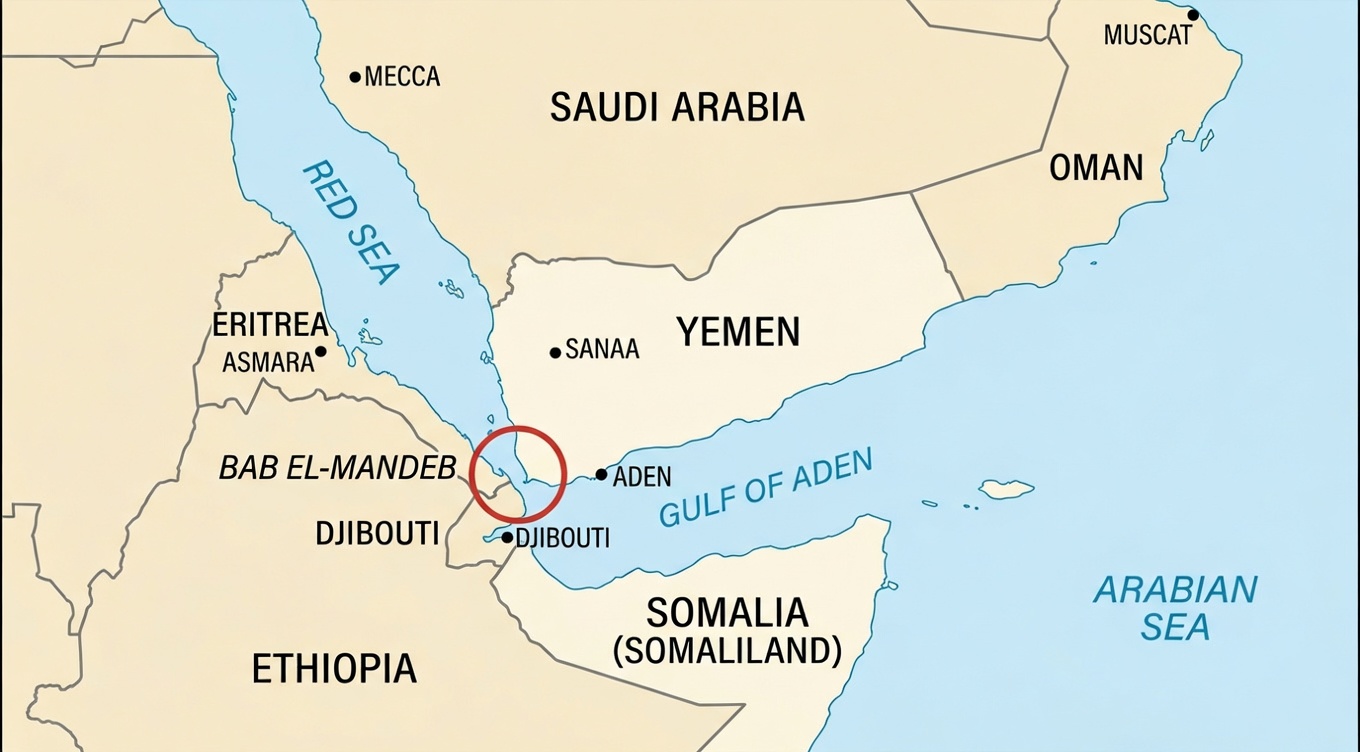
In late 2023, Houthi forces in Yemen began targeting commercial vessels in the Red Sea with drones and anti-ship missiles. Within weeks, some of the world's largest container shipping companies had rerouted their fleets around the Cape of Good Hope, adding thousands of miles and several weeks to each voyage. Insurance premiums spiked. Fuel costs climbed. Supermarket shelves in Europe registered the first tremors of delay. The Houthis controlled no navy, held no deep-water port, and commanded no air force. What they controlled was access to a twenty-mile-wide passage at the southern end of the Red Sea - and that was enough.
Bab el-Mandeb, the strait separating Yemen from Djibouti and Eritrea, is one of the most consequential pieces of maritime geography on earth. It is also one of the least discussed until something goes wrong. The name translates roughly as "Gate of Tears" in Arabic, and the history of the strait suggests the name was chosen with foresight. Understanding Bab el-Mandeb means understanding how a localized conflict in a country most people could not have found on a map a decade ago became a direct threat to global commerce, energy markets, and the naval calculus of every major maritime power.
Why Bab el-Mandeb Matters Now
The Red Sea corridor handles roughly 12 to 15 percent of global trade, depending on the year and the commodity. For European importers buying Asian goods, or for Gulf oil exporters moving crude to European refineries, the Suez Canal route through the Red Sea is not a preference - it is the economic baseline. Bab el-Mandeb is the southern door to that route.
What changed after 2023 was not the geography. It was the demonstrated willingness of a non-state actor, armed with relatively low-cost weapons supplied largely by Iran, to impose real costs on global commerce without seizing the strait outright. Disruption, it turned out, did not require control. It required only the credible threat of attack.
That lesson has not been lost on the strategists who watch the strait. Bab el-Mandeb sits at the intersection of several overlapping crises: the Yemen civil war, Iranian regional ambitions, Gulf security competition, and the long rivalry between Western naval power and states that would prefer to see that power diminished.
What the Bab el-Mandeb Dilemma Actually Means
The dilemma is not simply one of physical blockade. A full closure of the strait is difficult to sustain and would invite a military response that even the Houthis could not survive. The real dilemma is subtler: how do you protect a twenty-mile passage against an adversary whose strategy depends on creating uncertainty rather than seizing territory?
Convoy protection, naval escorts, and active missile defense can reduce the risk to individual vessels, but they cannot eliminate it at acceptable cost. The USS Carney and other U.S. Navy ships operating in the Red Sea spent tens of millions of dollars in interceptor missiles stopping drones and ballistic missiles worth a fraction of that amount. This cost exchange is the heart of the problem. The defender must be right every time to maintain confidence in the route. The attacker needs only occasional success to maintain uncertainty.
For shipping companies, uncertainty is as damaging as actual interdiction. A vessel routed around the Cape of Good Hope arrives late and burns more fuel. But it arrives. The calculation favors the long way round when the short way carries actuarial risk that underwriters price accordingly.
The Geography of the Chokepoint
Bab el-Mandeb is narrower than popular imagination tends to assume. The strait runs roughly 18 to 20 miles wide at its tightest point, divided by the Yemeni island of Perim into two channels. The larger, western channel handles the bulk of commercial traffic. The eastern channel is shallower and narrower, largely unsuitable for deep-draft tankers.
Yemen's Tihama coast commands the eastern approaches to the strait. The Yemeni highlands behind that coast provide elevation and concealment for radar systems, missile batteries, and surveillance assets. Whoever controls those highlands - and the Houthis have controlled much of them throughout the recent conflict - has a natural firing position that overlooks some of the world's busiest sea lanes.
On the western side, Djibouti hosts one of the most concentrated collections of foreign military bases in the world. The United States, France, Japan, China, and Italy all maintain facilities there. The base infrastructure reflects a long-standing consensus that Djibouti's position at the mouth of the Red Sea is worth garrisoning. That consensus has not prevented the current disruption, which says something important about the limits of basing rights when the threat comes from the other shore.
How a Bab el-Mandeb Crisis Would Work in Practice
The Houthi campaign after 2023 provided a working model. Attacks begin with surveillance - fishing vessels, coastal observers, satellite imagery provided by a patron state. Targeting data is passed to launch teams positioned on the Yemeni coast or on vessels operating in shallow inshore waters. Drones, cruise missiles, and ballistic missiles are fired in saturation patterns designed to overwhelm point defense systems.
The targeting in the Houthi campaign was often indiscriminate by intent. Ships with no connection to the stated political grievance were struck. The signal being sent was not "we can identify and destroy specific vessels" but rather "no vessel transiting this area is safe." That signal, once credible, is sufficient to reshape commercial routing decisions worldwide.
A state-level actor with more capable sensors, longer-range missiles, and naval support could do considerably more. Iranian anti-ship ballistic missiles, if accurately guided, could reach targets in the southern Red Sea from launch positions on the Iranian mainland or from proxies in Yemen. A deliberate campaign to close Bab el-Mandeb by a state actor backed by Iran would present a substantially harder military problem than the Houthi campaign alone.
How Regional Powers Have Tried to Manage the Vulnerability
Saudi Arabia and the UAE both have significant stakes in keeping Bab el-Mandeb open. Saudi crude exports move north through the Red Sea to the Suez Canal. Abu Dhabi's non-oil trade is heavily routed through the same corridor. Both countries have invested in the Yemen conflict partly as a way to prevent Iranian-backed forces from consolidating control of the strait's eastern approaches.
The results have been mixed at best. After nearly a decade of Saudi-led coalition operations in Yemen, the Houthis retained their coastal positions and demonstrated in late 2023 that they could project threat across the full width of the strait. Regional military capacity has improved but has not translated into the kind of ground control that would remove the threat at its source.
Egypt's concern is different in character but no less pressing. The Suez Canal generates roughly $9 billion in annual revenue for the Egyptian state. When shipping diverts around the Cape, that revenue falls directly. Egypt has neither the military reach nor the political position to address the Yemeni dimension of the problem unilaterally. Its vulnerability is structural.
The Alternatives to the Red Sea Route - and Why They Do Not Fully Answer the Problem
The Cape of Good Hope route works. Ships that took it during the Houthi campaign arrived. Cargo moved. The global economy absorbed the disruption without structural collapse. This fact is sometimes used to argue that Bab el-Mandeb is less critical than the alarmist reading suggests.
That argument holds for disruptions measured in months. It does not hold for sustained closure. The Cape route adds roughly 3,500 miles and seven to fourteen days to voyages between Asia and Europe, depending on origin and destination. That time costs money in fuel, crew hours, and vessel availability. Fleet capacity effectively shrinks because each ship completes fewer voyages per year. At scale, sustained diversion would tighten shipping capacity globally and push freight rates to levels that inflate the cost of traded goods across economies that have no direct stake in the conflict.
The Sumed pipeline across Egypt offers a partial alternative for crude oil - it can move around two million barrels per day - but it does not address container shipping, LNG, or the bulk commodities that define the volume profile of the Red Sea route. There is no pipeline for goods.
What Bab el-Mandeb Changes Operationally for Naval Forces
The strait is narrow enough that any naval force operating inside the Red Sea must pass through Bab el-Mandeb to reach the open ocean. During the Cold War, the Soviet Union maintained a presence in Aden partly to complicate Western naval freedom of movement in and out of the Red Sea. The logic has not changed; the actors have.
For the U.S. Navy, the strait represents both a commitment and a constraint. Carrier strike groups entering the Red Sea are operating in a confined sea with limited room to maneuver, against adversaries that have already demonstrated the ability to fire ballistic missiles and saturate defenses with drones. The calculus of forward presence in confined seas has shifted since the era when carrier presence was itself deterrent.
For China, which has a naval base in Djibouti and growing commercial stakes in Red Sea transit, Bab el-Mandeb presents a different kind of challenge. The People's Liberation Army Navy is not yet structured for sustained independent power projection in the Indian Ocean region. Chinese commercial exposure to Red Sea disruption is real - Chinese shipping companies lost revenue during the Houthi campaign - but China's military response options remain limited by reach and by the political complications of acting alongside Western naval forces it elsewhere competes with.
Common Misconceptions About Bab el-Mandeb
The first misconception is that physical blockade is the only form of strategic denial. The Houthi campaign demonstrated that the threat of attack, sustained over time, achieves much of the same commercial effect without requiring any force to physically occupy the strait. Strategic denial by deterrence is cheaper and harder to reverse than blockade by presence.
The second is that naval escort solves the problem. It reduces individual risk. It does not eliminate it, and it does not address the cost exchange problem that makes sustained defense expensive relative to sustained attack.
The third misconception is that the strait's importance is primarily about oil. Crude and refined products are significant, but the container shipping volume - electronics, consumer goods, automotive parts - is equally exposed. The economic geography of Bab el-Mandeb is broader than the energy trade narrative suggests.
Limits and Risks in Using Bab el-Mandeb as Leverage
For any actor attempting to use the strait as leverage - whether a state or a proxy force - there are real ceilings on what can be achieved. Sustained disruption invites military response. The Houthi campaign drew U.S. and UK strikes on Yemeni territory. A more capable state actor threatening the strait would draw a more capable response.
There is also the problem of undiscriminating damage. Iran, which supports the Houthis, also has trading relationships and energy customers whose supply chains run through the Red Sea. China, the largest customer for Gulf crude, has never been comfortable with Houthi attacks that risk Chinese-flagged or Chinese-chartered vessels. The proxy tool has its own interests, and those interests do not always align cleanly with the patron's strategic objectives.
The leverage is real, but it is bounded. States that have used or tolerated strait disruption as a coercive instrument have historically found that the tool produces short-term pressure but rarely achieves durable strategic change - and sometimes produces military escalation that was neither intended nor manageable.
Future Implications
The Houthi campaign has permanently altered the risk calculus for commercial shipping in the Red Sea. Even after a political resolution in Yemen - whenever that comes - insurance underwriters, shipping executives, and fleet managers will carry the memory of 2023 and 2024 in their models. Risk premiums for the Red Sea corridor will not return to pre-conflict levels quickly. That elevated baseline cost has long-term implications for the economic geography of global trade.
Militarily, the campaign has accelerated thinking about low-cost asymmetric threats to maritime chokepoints. Every adversary with access to cheap drones and anti-ship missiles, and proximity to a strategic waterway, will have studied what the Houthis achieved. Bab el-Mandeb will not be the last strait where this logic is tested.
The longer-term strategic question is whether the international community can develop response mechanisms that do not simply pit expensive Western naval capability against cheap attrition attacks indefinitely. That question does not yet have a settled answer. What is settled is that Bab el-Mandeb has joined the Strait of Hormuz and the Strait of Malacca as a waterway whose disruption is a global event, not a regional one - and that the cost of keeping it open is now a permanent line item in the security budgets of every power that depends on what passes through it.
A twenty-mile passage at the foot of the Arabian Peninsula. The Gate of Tears lives up to its name.
Frequently Asked Questions
Where is Bab el-Mandeb and why does it matter for shipping?
Bab el-Mandeb is a strait roughly 20 miles wide at the southern end of the Red Sea, separating Yemen from Djibouti and Eritrea. It is the southern entry point to the Suez Canal route, which carries an estimated 12 to 15 percent of global trade. Ships traveling between Asia and Europe that use the Suez Canal must pass through Bab el-Mandeb. Disruption to that passage forces vessels onto the much longer Cape of Good Hope route, adding thousands of miles, weeks of transit time, and significant fuel costs to each voyage.
How did the Houthis disrupt shipping through Bab el-Mandeb without closing it?
Beginning in late 2023, Houthi forces launched drone and missile attacks against commercial vessels transiting the Red Sea. They did not physically block the strait. Instead, they created enough threat that major shipping companies rerouted their fleets to avoid the risk entirely. Insurance underwriters raised premiums for the corridor, which made the economics of transit worse even for ships that were not struck. The strategy demonstrated that sustained uncertainty about safety is commercially damaging even when most vessels pass through unharmed.
What countries have military bases near Bab el-Mandeb?
Djibouti, on the western shore of the strait, hosts military facilities belonging to the United States, France, Japan, China, and Italy, among others. The concentration of foreign bases there reflects a long-standing judgment that the strait's position is strategically valuable enough to garrison. Despite that presence, the Houthi campaign after 2023 demonstrated that basing rights on one shore do not prevent an adversary on the opposite shore from threatening traffic in the channel.
Is there an alternative route if Bab el-Mandeb is blocked?
The main alternative is routing around the Cape of Good Hope at the southern tip of Africa. That route is viable - ships that used it during the Houthi disruption arrived at their destinations - but it adds roughly 3,500 miles and one to two weeks to voyages between Asia and Europe. At scale, that extra distance reduces how many voyages each vessel can complete per year, effectively tightening global shipping capacity and pushing freight rates higher. There is also the Sumed pipeline across Egypt for crude oil, but it has limited capacity and does not carry container cargo.
What does Bab el-Mandeb mean for the U.S. Navy operationally?
Naval forces entering the Red Sea through Bab el-Mandeb are operating in a confined sea with limited room to maneuver. During the Houthi campaign, U.S. Navy ships expended costly interceptor missiles - in some cases worth far more than the drones they destroyed - defending commercial traffic. This cost exchange problem is a standing operational concern. Any adversary with cheap munitions and coastal access can impose ongoing costs on defensive naval operations without matching the defender's overall military capability. That asymmetry has sharpened debate about how forward naval presence should be structured in confined, threat-dense waters.