The secutirty build up for the 2026 world cup
By Declan Farr · June 21, 2026
Category: tactics-and-doctrine
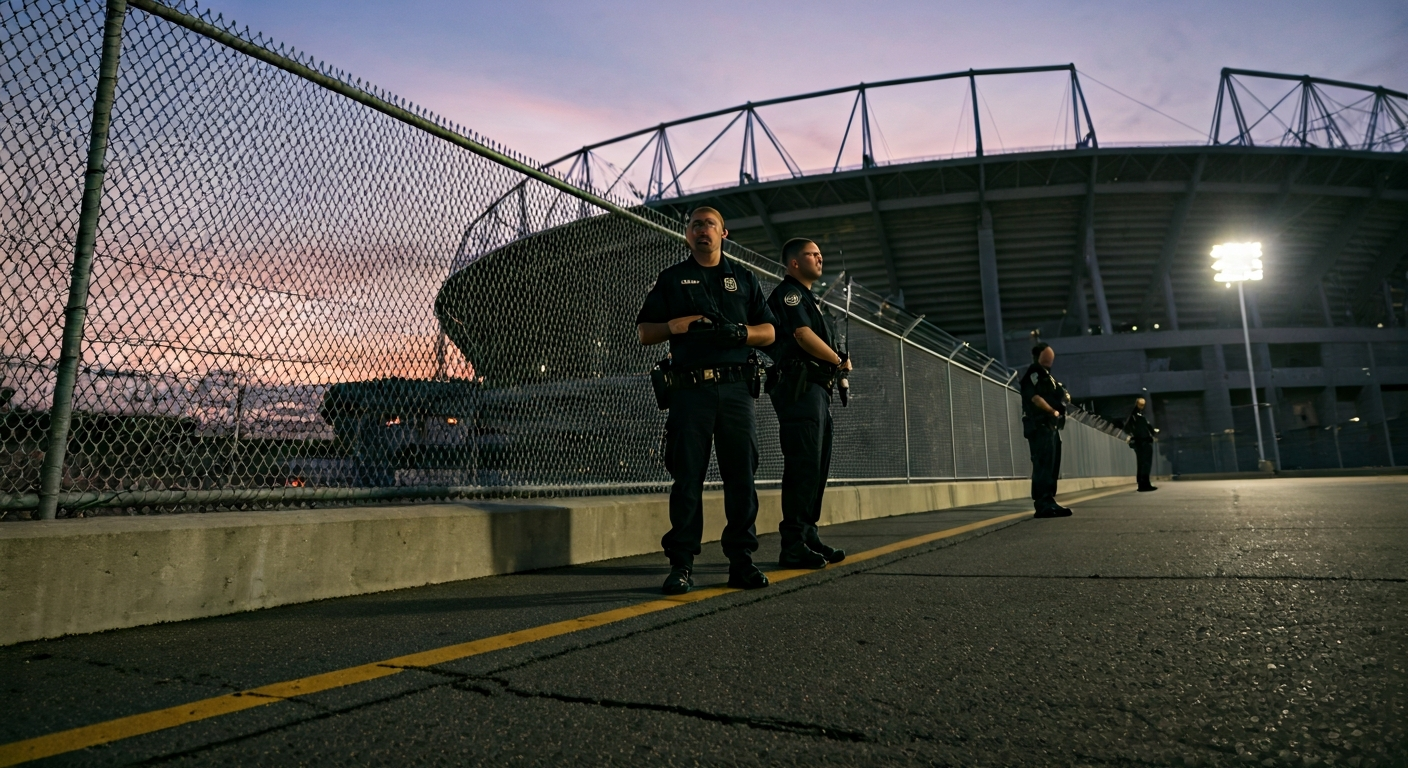
The 2026 World Cup security buildup spans $365 million in counter-drone systems, AI-assisted border management, and a trilateral coordination architecture that will be stress-tested across 16 cities and three sovereign nations.
Key takeaways
The problem Securing a three-nation, 16-city tournament requires more than hardware - it requires integrated command across different legal systems.
Core insight Detection technology has advanced faster than the legal and institutional frameworks needed to act on what it finds.
Practical outcome Track joint exercises and integration milestones, not procurement announcements, to gauge whether the security architecture is truly ready.
The 2026 FIFA World Cup is already the largest football tournament ever staged - 48 teams, 80-plus matches, 16 host cities spread across three sovereign nations, and somewhere north of five million attendees expected to pass through venues before the final whistle blows. That scale alone would stress any security architecture. The addition of modern drone technology, cross-border intelligence-sharing requirements, and an evolving cyber threat environment means the security buildup for this tournament is less a single procurement exercise and more a live stress test of how the United States, Canada, and Mexico can coordinate protection at continental scale.
The technologies being deployed span counter-drone systems, AI-assisted border management, real-time surveillance networks, and hardened command infrastructure. Some of it is drawn from existing military and law enforcement inventory. Some of it is new procurement, still being integrated. And some of it remains publicly vague - vendor announcements without independent performance verification, capability claims that planners will need to validate under operational conditions before the tournament concludes.
What Security Technologies Were Announced for 2026 World Cup Venues
The most heavily publicized element of the technology buildup is counter-drone capability. The United States has committed approximately $365 million toward drone-focused security for the tournament, a figure that covers detection networks, neutralization systems, and associated command infrastructure across the 11 American host cities.
Two companies have received significant attention in public reporting. Fortem Technologies' DroneHunter system uses net-capture to physically intercept unauthorized drones without deploying kinetic munitions or radio-frequency jamming that would disrupt civilian communications in and around densely packed stadium environments. Ondas Holdings' Sentrycs system takes a different approach - passive radio-frequency detection to identify and track drone operators by their control signals, allowing security teams to locate the source rather than simply the vehicle. A separate system called Odin has been described in reporting as a passive RF detection network performing a similar operator-location function.
On the border management side, an AI-powered digital assistant called COMPASS has been announced as part of the entry and accreditation management system. COMPASS is designed to handle the volume of credential checks and entry requirement queries across three nations with different documentation standards - a genuine operational problem given the cross-border movement expected throughout the tournament.
What remains publicly vague is the full specification picture. Detection range figures for the deployed drone systems, false-positive rates under stadium conditions - crowd noise, electronic interference from broadcast infrastructure, weather - and the precise degree of integration between different vendor platforms have not been independently published. Planners and vendors have not released this level of technical detail, which is normal for active security operations but makes independent assessment difficult.
Why This Security Buildup Matters Operationally
Mass-gathering security at this scale is a different problem category than protecting a single venue or a national capital. Consider the scenario: a credible threat alert arrives 48 hours before a quarterfinal match. The alert involves a suspected weaponized drone, and the origin of the intelligence crosses two national jurisdictions. The Sentrycs or Odin RF detection network at the stadium perimeter will identify drone signatures in the airspace above the venue - but translating that detection into a response requires the alert to move through an integrated command system, reach personnel with both the legal authority and the physical means to act, and do so within the decision window before a threat becomes an incident.
That chain - detection, classification, decision, response - has to function reliably across 16 cities, in some cases simultaneously, with security teams that trained on these systems at different rates and under different national legal frameworks. The FBI has conducted counter-drone training specifically oriented toward World Cup scenarios, which addresses part of the human-factors problem. But the integration layer - where a drone detection alert from one vendor system needs to communicate clearly with a command center running a different platform - is where large multi-vendor security architectures historically develop friction.
The threats this technology is designed to address are not hypothetical. Small commercial drones have demonstrated the ability to reach sensitive locations, and weaponization concepts have been documented in conflict environments and in domestic extremist planning. The tournament also presents the full range of mass-gathering threats: unauthorized access, crowd surge, smuggling, and the kind of lone-actor incidents that are difficult to predict through traditional intelligence channels.
Production and Deployment Reality at Named Venues
Publicly available reporting does not yet specify which individual venues are fully operationally integrated versus still in testing or final system certification. What is documented is that the DroneHunter net-capture system and Sentrycs were both selected and publicly announced in advance of the tournament - the Sentrycs selection was reported in February 2026 - which suggests these platforms have moved beyond concept phase into active deployment preparation.
The supply chain picture for counter-drone technology generally involves semiconductor dependencies for signal processing hardware and optical components for tracking payloads. Neither Fortem Technologies nor Ondas Holdings has publicly disclosed sourcing vulnerabilities, and reporting to date has not flagged specific single-source component risks. That absence of detail does not mean the risks don't exist; it means they have not been publicly aired, which is a different thing.
Training and staffing represent a genuine readiness variable. The FBI's counter-drone training program is documented, but the number of personnel certified across all 16 host cities, the timeline to completion, and whether any cities are running behind schedule has not been reported with precision. Tournament-scale security operations typically require hundreds of trained operators across a security architecture this distributed. If operator readiness at any venue lags behind system deployment, the technology is present but the response capacity is not.
Cost, Sustainment, and Readiness
The $365 million figure attached to U.S. drone security is the clearest budget number in the public record. Full-spectrum security technology costs - covering surveillance, screening, access control, command centers, cybersecurity, and communications infrastructure - across all three host nations have not been consolidated into a single publicly released figure. The trilateral nature of the tournament complicates cost attribution, since each nation is funding its own security infrastructure with coordination at the federal level rather than from a shared pool.
Sustainment is a genuine post-tournament question. Systems installed at NFL stadiums and other permanent venues may remain in place after the tournament ends - which changes the cost calculus from a one-time deployment to an ongoing operational commitment. Temporary installations at training sites and smaller venues will presumably be decommissioned. Which systems transition to permanent infrastructure and which are demobilized has not been publicly specified by any of the three host governments.
The cybersecurity dimension adds a sustainment layer that is not always visible in procurement discussions. Govtech reporting has flagged ransomware attacks on local government dispatch and surveillance infrastructure as a realistic threat during high-attendance periods. The systems supporting the World Cup involve a large number of contractors and temporary vendors, each of which represents a potential entry point. Supply chain security across that many third parties is operationally difficult to enforce uniformly, particularly in the compressed timeline of a live tournament.
Political and Alliance Context
The trilateral coordination problem is not primarily technical - it is legal and institutional. The United States, Canada, and Mexico operate under different frameworks governing surveillance, search and seizure, and intelligence sharing. A drone detection alert that requires cross-border operator tracking implicates different legal authorities depending on which side of which border the operator is standing on. Those frameworks do not resolve themselves because a large sporting event is underway.
COMPASS, the AI-assisted border management system, is designed partly to bridge the documentation and entry-requirement differences between three national systems. But digital border management at this scale also raises civil liberties questions that domestic advocacy organizations in all three countries have not been quiet about. Cross-border biometric data sharing, surveillance of travelers, and the legal status of AI-assisted credentialing are active political pressure points, not settled questions.
Private contractors and international vendors are deeply embedded in the technology stack. Which vendors have ties to foreign governments, and whether any of the component supply chains create foreign investment sensitivities, has not been fully addressed in public reporting. Export control considerations are relevant for some of the more capable detection and neutralization systems - particularly where those systems have dual-use military applications.
Key Risks and Vulnerabilities in the Security Architecture
The most significant technical risk is integration failure between vendor platforms. A facial recognition alert from one system generating a different threat classification than an RF detection alert from another - with both arriving simultaneously at a command center during a high-stress period - is exactly the kind of ambiguous-data scenario that produces decision paralysis or, worse, contradictory responses from different elements of the security force. Multi-vendor architectures at this scale almost always produce these moments. The question is whether procedures exist to resolve them quickly.
Weather and environmental degradation are operational constraints that vendor marketing materials tend to understate. Stadium environments - crowd noise, broadcast RF interference, lighting conditions, precipitation - affect sensor performance in ways that controlled-environment testing does not fully replicate. The first operational indication of a system's real false-positive rate often comes during the event itself.
An adversary probing the security architecture would likely look first at the integration seams - the communication pathways between different national systems, the handoff points between vendor platforms, and the human decision layer where ambiguous alerts require judgment. Cyber intrusion into command infrastructure, jamming of communication links between detection systems and response teams, or spoofing of drone signatures to generate false alerts and exhaust response resources are all documented attack concepts against sensor-based security systems.
Human factors remain the variable most resistant to technology solutions. Operator fatigue across a six-week tournament, communication breakdowns between agencies operating under different legal frameworks, and the cognitive load of managing multiple simultaneous alert streams are not engineering problems. They are training, staffing, and command-design problems - and they are harder to observe from outside the security architecture than system integration progress.
What To Watch Before the Tournament Concludes
The key observable indicators of readiness are joint exercises between U.S., Canadian, and Mexican security agencies - specifically exercises that test the integrated command layer rather than individual platform performance. Published joint security plans, announced multi-agency drills, and vendor performance reports following venue test events are the most reliable public signals of whether the integration architecture is functioning as designed.
If a major system fails integration testing, the contingency question is whether it gets replaced, redesigned, or deferred to a fallback procedure. Who makes that decision, and how quickly, varies by system and by which national authority owns the contract. Budget amendments and personnel hiring announcements at specific venues can signal where gaps are being addressed reactively.
The evolving drone threat is itself a moving target. Drone capabilities documented in conflict environments continue to advance, and the gap between what systems are designed to counter and what an adversary might deploy can close faster than procurement cycles allow. Mid-course corrections are possible but operationally costly when integration work is already underway.
Final Assessment of the 2026 World Cup Security Technology Buildup
Based on available public reporting, the security technology buildup for 2026 is substantially underway and operating on a recognizable procurement timeline, with major counter-drone systems selected and announced well in advance of the tournament. The $365 million U.S. commitment to drone defense is a serious investment, and the selection of platforms like DroneHunter and Sentrycs reflects a genuine attempt to address the most operationally visible threat vector.
The gaps that cannot be closed by procurement alone are the integration layer, the legal-framework differences between three sovereign nations, and the human-factors problem across a six-week, 16-city operational tempo. Technology can detect. It cannot, by itself, ensure that the detection generates a timely and legally coherent response across three different national command authorities.
What this buildup reveals about mass-gathering security more broadly is that the technology has outpaced the institutional architecture required to use it effectively. Detection capability is advancing faster than the legal frameworks, data-sharing agreements, and cross-agency training pipelines that convert sensor alerts into protective action. The 2026 World Cup will be, among other things, a large-scale field test of whether that gap can be managed under operational pressure. The result will inform how planners approach the next event of this scale - and there will always be a next event.
Frequently Asked Questions
What specific security technologies will be used at 2026 World Cup venues?
Confirmed platforms include Fortem Technologies' DroneHunter net-capture system, Ondas Holdings' Sentrycs RF-detection system for locating drone operators, and a passive detection network called Odin. The AI-assisted border management tool COMPASS has also been announced to handle accreditation and entry requirements across three nations. Full technical specifications - detection ranges, false-positive rates, and integration details - have not been publicly released.
How do the United States, Canada, and Mexico coordinate security across three countries?
Coordination operates through federal-level security planning between the three governments, with the FBI taking a leading role in counter-drone training and threat assessment on the U.S. side. The trilateral challenge is significant because each nation operates under different legal frameworks governing surveillance and intelligence sharing, meaning cross-border threat responses require advance agreements about authority and data handling. The precise structure of the joint command layer has not been fully disclosed publicly.
How much is being spent on 2026 World Cup security technology?
The United States has committed approximately $365 million specifically toward drone-focused security systems across its 11 host cities. A consolidated figure covering all security technology - surveillance, screening, access control, cyber defense, and communications - across all three host nations has not been released. Cost-sharing arrangements between the three governments have not been detailed in public reporting.
How are weaponized drones being addressed at World Cup stadiums?
The primary approach combines passive RF detection - identifying drone operators by their control signals before the drone reaches the venue - with physical net-capture systems that intercept drones without using jamming that would disrupt civilian communications. The FBI has conducted specific counter-drone training for officers working the tournament. Planners have also been briefed on lone-actor scenarios involving weaponized commercial drones, which represent the most difficult detection challenge because they may not follow predictable flight patterns.
What are the biggest cybersecurity risks for the 2026 World Cup?
Security analysts have identified ransomware attacks on local government systems - dispatch, surveillance infrastructure, permitting - as a realistic threat during high-attendance periods. Supply chain risk is also significant: many systems will be operated by contractors and temporary vendors, each representing a potential intrusion point. Planners have not yet publicly released detailed contingency procedures for cyber incidents affecting command or surveillance infrastructure during the tournament.